
In the professional lighting world, LED neon (often called Neon Flex) represents a specialized category of diffusers designed specifically for installations requiring rounded shapes and organic curves. While standard aluminum profiles excel at straight architectural lines, LED neon provides the flexibility needed to transform a lighting design into a fluid, glowing masterpiece.
The Pitfalls of Integrated Neon Strips #
Many suppliers offer LED neon as a pre-assembled unit with the LED strip already integrated inside the silicone or PVC tube. However, industry experience suggests this can lead to significant reliability issues. For example, during a major 1.4-kilometer installation in Rwanda, approximately 10% of integrated neons failed immediately upon unboxing, necessitating constant maintenance and shutdowns during the event.
To ensure long-term stability, it is highly recommended to purchase neon profiles and LED strips separately. By sliding professional-grade strips (like the 12V WS2815) into the neon housing just before installation, you protect the delicate internal components from mechanical stress during shipping and handling. This “modular” approach allows installations to operate reliably for years rather than days.
Choosing the Right Tool: Events vs. Rentals #
LED neon is an ideal solution for one-time events where a specific, high-impact shape is required for a short period. However, for rental companies looking for equipment that can be used repeatedly across different projects, neon is often an impractical choice due to the difficulty of re-shaping and re-mounting it without damage.
For recurring rental applications, modular LED bars such as the ProfiLED system are a much more robust alternative. These bars offer the same smooth diffusion and pixel-mapped visuals but are housed in rigid, black anodized aluminum that handles the rigors of touring far better than flexible silicone.
Mounting Challenges in Permanent Installations #
Securing LED neon in a way that looks polished and professional can be difficult. While mounting clips (or “studs”) are commonly used, they are often visible to the viewer and do not always maintain the precise tension required to hold complex shapes over time.
For a truly high-end finish in permanent architectural or drywall installations, the best method is to cut a dedicated channel directly into the wall surface. Recessing the LED neon into these custom-routed shapes provides a “seamless” look where the light appears to emerge directly from the architecture without visible hardware.
Achieving Smoothness: The 3cm Rule #
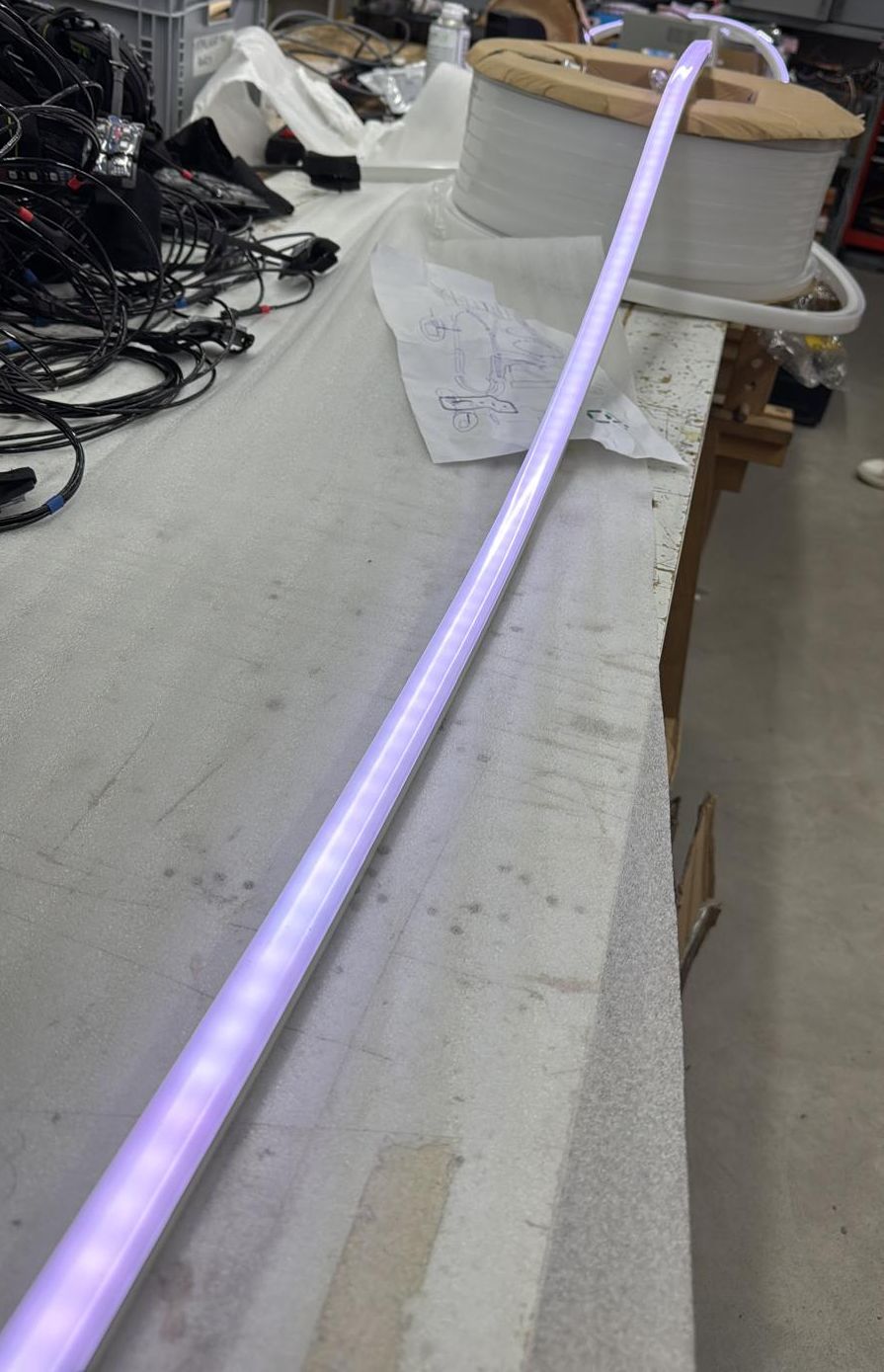
Just as with aluminum profiles, the primary goal of LED neon is to hide individual LED “dots” to create a continuous line of light. To achieve a perfectly uniform “neon” glow when using standard 60 LEDs/m pixel strips, the housing must provide a depth of at least 3cm between the strip and the surface of the diffuser. If the neon profile is too shallow, the individual pixels will remain visible, breaking the illusion of a solid light source.
Bending Limits Matter #
Even though LED neon is flexible, every product has a minimum bending radius. Forcing tighter curves than specified can damage the PCB inside or create uneven light distribution. Good design always starts with respecting the physical limits of the material instead of shaping it by force.
Creative and Budget-Friendly Alternatives #
For artistic projects with extremely tight budgets—such as wrapping trees or creating large-scale “junk art” sculptures—professionals sometimes use electrical conduit (plastic protection tubing used for wall wiring) as a makeshift neon diffuser. While not as refined as professional silicone Neon Flex, these tubes provide a unique aesthetic for strange 3D shapes and can be a cost-effective way to achieve large-scale light art.
Production Timelines and Material Logistics #
Much like aluminum profiles, there is an immense variety of LED neon types available on the market, differing in bend direction (horizontal vs. vertical), color temperature, and thickness. Because no single company can stock every possible variation, materials are almost always purchased to order for each specific project. When planning your installation, you should account for a minimum lead time of 4 weeks for the production and delivery of professional-grade neon materials.
Advanced Mapping for Curved Designs #
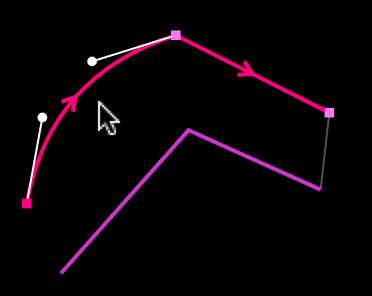
Precise mapping is the critical bridge between your creative vision and the physical installation. LED Strip Studio software excels in this area by providing an advanced mapping editor that allows you to control addressable LEDs regardless of their shape, size, or placement. A standout feature for neon projects is the software’s ability to draw smooth curves in mapping, utilizing vectors and Bezier curves that can be further modified to match the exact geometry of your physical installation. These advanced tools allow designers to map circles and other complicated LED objects in a matter of minutes, ensuring that animations flow perfectly along rounded surfaces without the distortions common in standard linear mapping. This specialized functionality makes LED Strip Studio the ideal mapping solution for the organic and flowing shapes inherent to professional LED neon designs.
Turning LED Neon into a Reliable Design Tool #
LED neon allows lighting designers to move away from straight, rigid shapes and create softer, more natural forms with flowing lines that can follow almost any design. To work properly in real installations, it should be treated as a precise system, not just a ready-made product. For better reliability, it is important to keep the LED strip and the neon housing separate until installation, choose solid mounting methods for long-term use, and understand how light spreads inside the diffuser so the result stays smooth and without visible LED dots. When LED neon is combined with modern pixel mapping tools like LED Strip Studio, curved lighting becomes much easier to plan, simulate, and control, even in complex shapes, giving designers both freedom and accuracy. In the end, working with LED neon is about planning and control of materials, shape, and light behavior, which turns curved lighting from a challenge into a powerful tool for creating strong visual effects and storytelling with light.
What's the difference between LED neon flex and regular aluminum profile LED strips?
Aluminum profiles are rigid and create straight, architectural lines — they can’t be bent into curves without approximating them with short segments. LED neon flex is a silicone extrusion that bends freely in one direction, making it the right choice for circles, organic curves, letters, and decorative shapes. Neon flex also gives a more continuous, glowing appearance similar to traditional neon signs, while aluminum profiles with frosted diffusers look more like linear architectural light.
Why do some LED neon strips fail so quickly?
Pre-assembled neon where the LED strip is permanently bonded inside the silicone housing is fragile — the strip gets stressed during shipping and handling before installation even starts. A 1.4km installation in Rwanda saw 10% failure rate right out of the box with integrated neon. The more reliable approach is to buy the neon housing and LED strip separately and slide the strip in just before installation, protecting it from mechanical stress during transport.
How do I mount LED neon so it looks clean and professional?
For the highest-end finish in permanent installations, cut a channel directly into the wall or surface and recess the neon into it — the light appears to emerge from the architecture with no visible mounting hardware. For simpler applications, mounting clips are common but will be visible. Whatever method you use, make sure the neon is held under consistent tension — sagging or uneven mounting makes curves look sloppy.
How long does it take to get LED neon materials for a project?
Plan for at least 4 weeks from order to delivery for professional-grade neon profiles. There are dozens of variations in terms of bend direction, thickness, and color temperature, and most suppliers don’t stock every type. Order your neon profiles as soon as the design is finalized — waiting until the last minute is one of the most common causes of project delays.
Is LED neon a good choice for rental events?
Generally not for recurring rentals. Neon flex is hard to reshape and remount for different events without damaging it, and it’s more fragile in transport than rigid LED bars. For rentals, modular rigid LED bar systems like the ProfiLED are a much better choice — they give a similar smooth diffused appearance but are built to survive repeated transport and setup. Save LED neon for one-time permanent or event installations where the specific shape justifies it.