
Every addressable LED strip has a brain. That brain is the IC — the integrated circuit that receives the SPI data signal from your controller and translates it into color values for the LEDs. The question is where that brain lives: inside the LED package itself, or as a separate chip mounted alongside it on the PCB. This isn’t just a manufacturing detail. It affects resolution, reliability, voltage requirements, and how your pixel LED installation holds up years down the line.
What Does an IC Actually Do in a Pixel LED Strip? #
The IC is what makes a digital LED strip different from an analog one. In an analog strip, every LED on the same channel changes together — one color for the whole strip, controlled by voltage. In a digital RGB LED strip, each IC receives a data packet telling it exactly what color to display, and passes the remaining packets down the chain to the next IC. This is how you get individual pixel control, animations, video content, and all the effects that make pixel LED installations visually interesting.
The IC interprets the SPI protocol — which is why your SPI LED controller or Art-Net to SPI converter needs to know exactly which IC it’s talking to. WS2811, WS2812B, WS2815, SK6812, APA102, TM1803 — these are all different IC families with different electrical characteristics, timing requirements, and capabilities. Your pixel LED controller must be configured to match.
What Is an Internal IC Strip? #
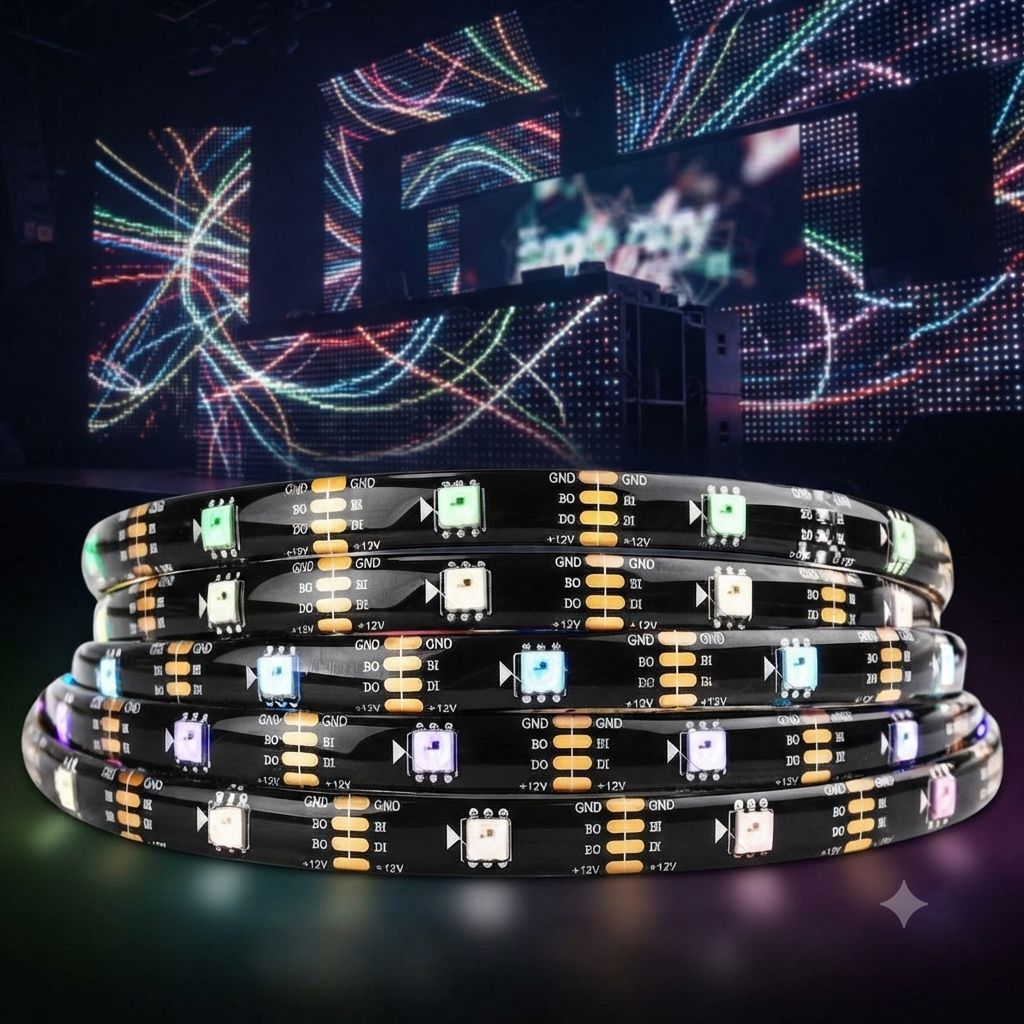
An internal IC strip embeds the control circuit directly inside the LED package — the same tiny component that contains the actual light-emitting diodes. The WS2815 LED strip is the most common example used in professional installations today. You can’t see a separate chip on the PCB because there isn’t one — the IC is sealed inside the 5050 SMD LED itself.
The most important practical result of this is 1:1 resolution at 12V. Each individual LED is its own addressable pixel. This might sound obvious, but it’s actually a significant technical achievement at 12V — earlier designs at higher voltages had to group multiple LEDs per IC to manage the voltage and power budget.
The WS2815 also introduced a dual-signal backup line. If a single pixel is physically damaged — cracked solder joint, mechanical stress, a failed LED — the data signal doesn’t stop. The backup line carries a parallel copy of the data, and the strip keeps working from the next pixel onward. For a nightclub LED installation or TV studio LED lighting running 24/7, this is the difference between calling a technician and not calling a technician.
The 12V operating voltage also means voltage drop across the strip is much more manageable. A 12V addressable LED strip can run up to around 10 meters before requiring power injection, compared to 1–3 meters for a 5V LED pixel strip. Fewer injection points means cleaner wiring, less hardware, and a simpler installation overall.
ws2815_internal_ic.png
What Is an External IC Strip? #
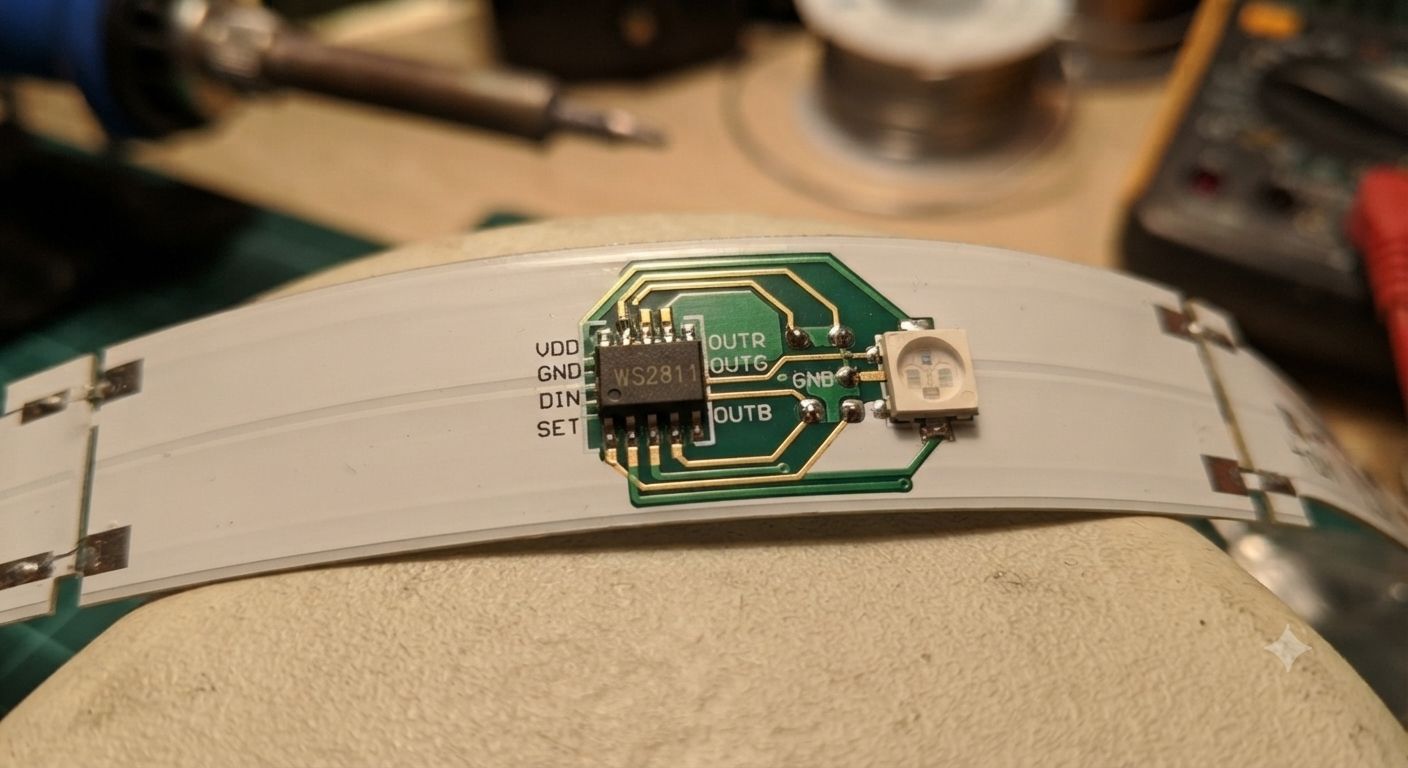
An external IC strip uses a separate discrete chip mounted on the PCB alongside the LEDs. The WS2811 LED strip is the classic example — you can see the small black SOP8 packages between the LED groups. One WS2811 chip controls a group of LEDs rather than a single one, typically one LED at 5V, three LEDs at 12V or six LEDs at 24V.
This grouping is the defining characteristic of the WS2811 for most buyers. The visual resolution is lower — each pixel covers three to six physical LEDs — but the cost is also lower, because you need fewer chips per meter and fewer controller output channels per installation. For large-scale architectural LED lighting or LED building facade lighting where the viewing distance is significant, this reduced resolution is often completely invisible and the cost savings are real.
The external chip design also gives manufacturers flexibility. They can pair the WS2811 with different LED types, voltages, and form factors without redesigning the LED package itself. This is part of why the WS2811 has been so widely adopted — it’s a flexible, proven circuit that works across a huge range of strip configurations.
The limitation is that there’s no backup data line. If a WS2811 chip fails or a data connection breaks, every pixel downstream goes dark. In a permanent installation, this means a service call. In a rental or touring scenario where strips take repeated physical stress, it means more frequent maintenance.
Comparison: WS2815 vs WS2811 #
| Feature | WS2815 (Internal IC) | WS2811 (External IC) |
|---|---|---|
| IC location | Inside LED package | Separate chip on PCB |
| Resolution | 1 LED = 1 pixel | 1–6 LEDs = 1 pixel |
| Backup data line | Yes | No |
| Operating voltage | 12V | 5V typically |
| Voltage drop tolerance | Good (up to ~5m) | Poor at 5V (1–3m) |
| Cost per meter | Higher | Lower |
| Best for | Permanent installs, studios, clubs | Large washes, facades |
Which Is Actually More Reliable? Our Real-World Experience #
This is where the spec sheet and the job site sometimes tell different stories.
In theory, the WS2815 with its internal IC and backup data line looks like the more resilient choice. And for permanent pixel LED installations — fixed in place, climate-controlled environments, wiring that never moves — it genuinely is. We use WS2815 strips extensively for nightclub, hotel, and broadcast installations, and when the strips are manufactured with gold bond wires internally (rather than the alloy wires used in budget versions), they’re extremely reliable. The gold wires resist oxidation and handle thermal cycling far better. In these conditions, WS2815 is our go-to.
In practice, the story changes when the installation involves physical stress — repeated assembly and disassembly, transport vibration, or harsh mechanical environments. The internal IC design that makes WS2815 robust in a fixed installation becomes a weakness when the LED package itself is under mechanical strain. The IC and the LED diodes are crammed into the same 5050 package, and physical damage to the lens or solder points can take out both.
The 5V voltage issue is also real. A 5V LED pixel strip like WS2812B requires power injection roughly every 1–3 meters depending on the pixel density and current draw. In a large installation, that’s a significant number of injection points — more connectors, more potential failure points, more labor.
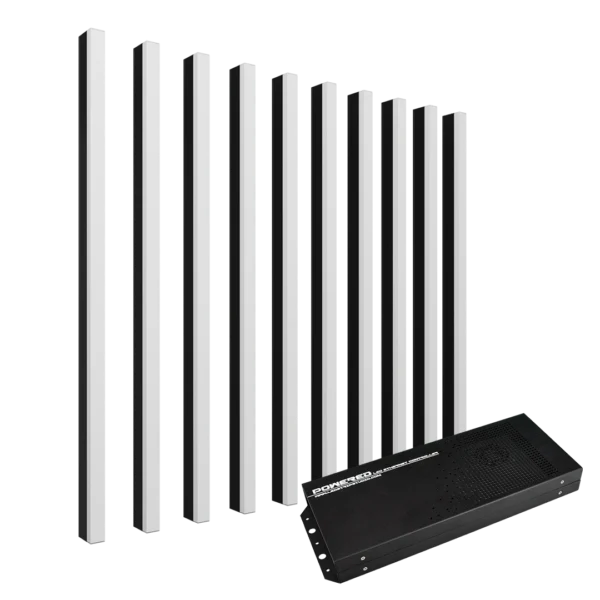
This is why the ProfiLED bar — our modular rental LED bar system — is built around external IC strips rather than internal ones. In a rental product that gets packed, shipped, unpacked, and rigged hundreds of times, the ability to have the data chain survive individual LED failures matters more than per-LED resolution. External chips are also physically easier to inspect, test, and replace when something does go wrong.
So Which Should You Choose? #
For a permanent LED pixel installation — a club ceiling, a TV studio set, a hotel lobby, a building facade — use WS2815. The 12V voltage, the per-pixel resolution, and the backup data line are exactly what you want for a fixed installation that runs continuously and needs minimal maintenance. Specify strips with gold bond wires when sourcing — the quality difference is significant even if it’s not visible to the eye.
For large-scale architectural LED lighting or outdoor LED pixel installation where resolution is secondary to coverage area and budget, WS2811 at 5V, 12V or 24V is a perfectly solid choice. The lower per-pixel cost can make a meaningful difference on large facade or perimeter installations where you need hundreds of meters of strip.
For rental, touring, or high-abuse environments — event stage LED lighting, LED drumming suits, LED dance suits, modular LED bar system products that travel — external IC designs hold up better to the physical reality of life on the road. Lower per-LED resolution is generally acceptable in these use cases anyway, since the products are viewed at a distance.
Professional pixel LED controllers from LED Strip Studio — the LEC3, the REACTIVO, and the SPI Matrix — support all of these IC families natively. Whether you’re running WS2811, WS2812B, WS2815, SK6812, or APA102, the controller handles the SPI protocol translation automatically. You configure the IC type in the software and everything downstream works correctly.
What is the difference between WS2811 and WS2815 LED strips?
WS2811 uses an external IC chip that controls groups of LEDs — typically 3 LEDs per pixel at 12V — making it lower resolution but more affordable. WS2815 embeds the IC inside each LED package for 1:1 per-LED control at 12V, and adds a backup data line so the strip keeps working if a single pixel is damaged. WS2815 is preferred for permanent professional installations; WS2811 is common for large-scale architectural washes where individual pixel resolution matters less.
Does WS2815 really keep working if one LED fails?
Yes — this is the backup data line feature. The WS2815 runs two parallel data lines: the primary and a backup. If a pixel is physically damaged and breaks the primary data path, the signal automatically continues from the backup line at the next functional pixel. Everything downstream of the damaged pixel keeps working. Standard WS2811 and WS2812B strips don’t have this — one failed chip means all pixels after it go dark.
Why does 5V matter for LED strip installations?
At 5V, Ohm’s law works against you — the same current draw creates much more voltage drop along the strip than at 12V or 24V. A 5V LED pixel strip like WS2812B typically needs power injection every 1–3 meters to maintain consistent brightness and color. In a large installation, that means many injection points, many connectors, and a significantly more complex wiring job. WS2815 at 12V can run up to around 10 meters without injection, which makes it far easier to wire in permanent installations.
Are external IC strips less reliable than internal IC strips?
Not necessarily — it depends on the environment. In permanent, fixed installations with climate control and no physical stress, WS2815 with quality gold bond wire construction is extremely reliable. But in high-stress environments — rental equipment, touring installations, products that get packed and unpacked repeatedly — external IC strips can actually be more durable. The IC and LED are separate components, so a failed LED doesn’t automatically take out the control chip, and the chips are easier to inspect and service. This is why professional rental LED bar systems like the ProfiLED use external IC designs.
What does "gold wire" mean in an LED strip and why does it matter?
Inside every LED package there are tiny bond wires connecting the chip to the electrical contacts. Budget strips use copper alloy wires, which oxidize over time, especially in humid or outdoor environments. Professional-grade strips use pure gold bond wires, which don’t oxidize and handle thermal cycling (heating up and cooling down repeatedly) much better. You can’t tell from the outside without a data sheet or magnification, but the quality difference shows up in longevity — particularly in permanent installations like nightclub LED installations or TV studio LED lighting that run thousands of hours per year.
Which pixel LED controller works with both WS2811 and WS2815 strips?
Professional LED pixel controllers like the LED Strip Studio LEC3 support both WS2811 and WS2815 — along with WS2812B, SK6812, APA102, TM1803, MBI6024, and over 90 other IC families. You configure the IC type in the LED Strip Studio software, and the controller adjusts its SPI output timing and protocol accordingly. This makes it straightforward to mix strip types in a single installation or upgrade from WS2811 to WS2815 without replacing the controller.