
In the lighting industry, choosing between regular analog LEDs (often called “dumb” strips) and pixel LEDs (known as addressable, digital, or smart LEDs) is the first step in defining the visual potential of a project. While they may look similar when turned off, their internal technology and control methods are fundamentally different.
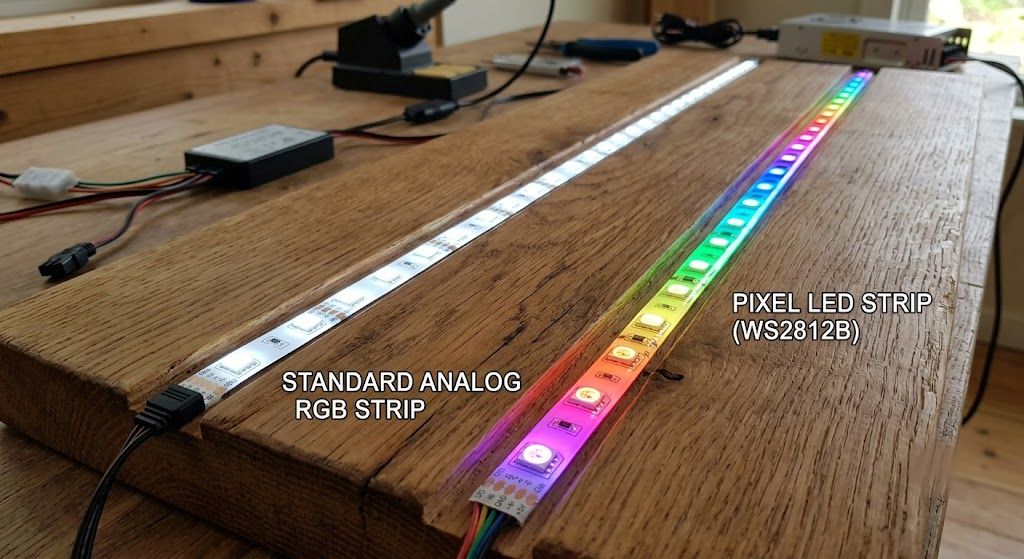
1. What are Regular Analog LEDs (“Dumb” LEDs)? #
Traditional or analog LED strips are designed to act as a single, uniform light source.
- Mechanism: In an analog setup, every light emitter in the chain performs the exact same action simultaneously. If the controller sends a command to turn blue, the entire strip turns blue; if you dim the lights, the entire strip dims together.
- Typical Control: These LEDs are usually controlled via Constant Voltage (CV) dimmers. They utilize Pulse Width Modulation (PWM), which rapidly pulses power on and off to adjust perceived brightness and color. The industry standard for managing these signals is the DMX512 protocol, which requires a DMX LED dimmer (such as the Lady Dimmer or MR. DIMMER) to translate instructions into electrical power for the strip.
- Typical Usage: Analog strips are the primary choice for ambient lighting and mood setting. They are ideal for architectural washes, under-cabinet lighting, or decorative accents in venues where uniform color is required across a large area.
2. What are Pixel LEDs (Addressable or Digital LEDs)? #
Pixel LEDs revolutionize lighting by allowing for micro-level control, treating each diode as an independent point of light.
- Mechanism: Each individual LED chip on a pixel strip contains its own Integrated Circuit (IC) or “brain”. This IC listens to a data feed, sets the specific color and brightness for its diode, and passes the remaining instructions to the next pixel in the line. This allows every single LED to display a different color or brightness independently of its neighbors.
- Typical Control: Addressable LEDs use Serial Peripheral Interface (SPI) protocols rather than simple power dimming. Because these installations often involve thousands of data points, they require specialized pixel controllers (like the LEC3 or SPI Matrix) to translate high-speed data from software. These systems typically receive data via Art-Net or sACN over Ethernet to handle the high channel counts required for pixel mapping.
- Typical Usage: Pixels are used to transform surfaces into dynamic visual canvases. They are perfect for creating flowing gradients, moving patterns, and video content that follows complex geometric shapes, such as building facades, 3D sculptures, or TV studio sets.
Summary Comparison Table #
| Feature | Regular Analog LEDs (“Dumb”) | Pixel LEDs (Addressable) |
|---|---|---|
| Control Unit | The entire strip acts as one unit. | Every individual LED diode can be controlled. |
| Internal Brain | None; strictly follows power input. | Each pixel has an Integrated Circuit (IC) chip. |
| Control Protocol | DMX512 (via a CV dimmer). | SPI (via a pixel controller). |
| Dimming Method | Pulse Width Modulation (PWM). | Data feed instructions (SPI). |
| Visual Capability | Static colors or whole-strip fades. | Complex animations, patterns, and video. |
| Best For | Ambient/Mood lighting & accents. | Immersive art, stage sets, and media facades. |
When to use pixel LEDs? #
If you need to create video effects or want to get the most out of LED strips, pixel LED strips are the better option. They allow full control over individual LEDs, enabling dynamic animations and advanced visual content.
When to use analog/regular LEDs? #
If you are using LED strips only to light up different sections of a scene and don’t need color changes along the length of the strip, analog LEDs are sufficient. They are typically easier to install and can be slightly cheaper due to simpler DMX512 control. However, in most cases, pixel LEDs are already the better choice in terms of visual performance and flexibility.
Can I run pixel LEDs and analog LEDs together in the same installation?
Yes, and it’s actually pretty common. You’d use a pixel controller for your addressable strips and a separate DMX dimmer for your analog zones, both connected to the same Art-Net network and controlled from one piece of software. This lets you get the wow-factor of animated pixel effects on key surfaces while using cheaper analog strips for general fill lighting.
Do pixel LED strips cost a lot more than regular analog ones?
They’re a bit more expensive per meter because each pixel has its own IC chip built in, but the price gap has narrowed a lot over the years. The bigger cost difference is usually in the controller — a pixel controller capable of handling thousands of individually addressed LEDs costs more than a simple DMX dimmer. For large installations, that hardware investment pays off in creative flexibility.
Can I control pixel LEDs from a standard DMX lighting console?
Yes, most professional consoles output Art-Net over Ethernet, and pixel controllers like the LEC3 receive Art-Net natively. You patch the LED outputs in the console just like any other fixture. The catch is that pixel LEDs eat up DMX channels fast — one RGB pixel uses 3 channels — so large installations need many universes, which is why Art-Net over Ethernet is standard rather than physical DMX cables.
Will pixel LEDs flicker on camera?
It depends on the IC type and how the controller is configured. Some older or budget chips run PWM at low frequencies that can cause visible flicker when recorded. For TV and broadcast work, choose chips with high PWM rates (like APA102 or SK6812) and confirm with a camera test before your shoot. Professional pixel controllers let you tune the refresh rate to avoid camera flicker.
How hard is it to install pixel LEDs compared to regular analog strips?
The physical mounting is similar, but the setup is more involved. Pixel LEDs need a controller, correct IC type configuration, and pixel mapping in software — steps that don’t exist with analog strips. That said, once you learn the workflow it becomes routine. Most of the learning curve is around pixel mapping and Art-Net configuration, not the actual wiring.
What’s the lifespan difference between analog and pixel LED strips?
Both types use similar LED diodes rated around 50,000 hours. The extra IC chip in pixel strips does add a small reliability risk, and in strips where the IC is integrated inside the LED package (like WS2812B), a failed chip kills that pixel. Strips like the WS2815 address this with a backup data line that keeps the rest of the strip working even if one pixel dies. For permanent installations, WS2815 or SK6812 are popular partly for this reason.