
Planning a digital pixel LED project requires a thorough understanding of more than just the price of a reel of lights. To build a reliable system for a club, TV studio, or building facade, you must account for the scale of the project, the density of the LEDs, and the “human factor” of installation labor.
How Much Will Your Pixel LED Installation Cost? #
Use the simple calculator below to estimate the cost of a pixel LED installation based on WS2815 LED strips. The calculations assume the use of a 200W (12V, 16.7A) power supply, which is commonly used in our installations.
Calculator Parameters #
| Parameter | Description |
|---|---|
| Strip Length (meters) | Total length of the LED strip in meters. |
| LEDs per Meter | Number of LEDs (pixels) per meter of strip. |
| LED Strip Price (USD/m) | Price of the LED strip per meter. |
| Controller Price per 4096 px | Cost of the controller. By default, the calculator assumes the use of the SPI Matrix PRO, which supports up to 4,096 pixels. |
| Labour Price (USD/hour) | Hourly rate of the technician performing the installation. |
| Power Supply Price (16.7A / 200W) | Cost of each power supply unit used in the installation. |
What’s Not Included in the Calculator? #
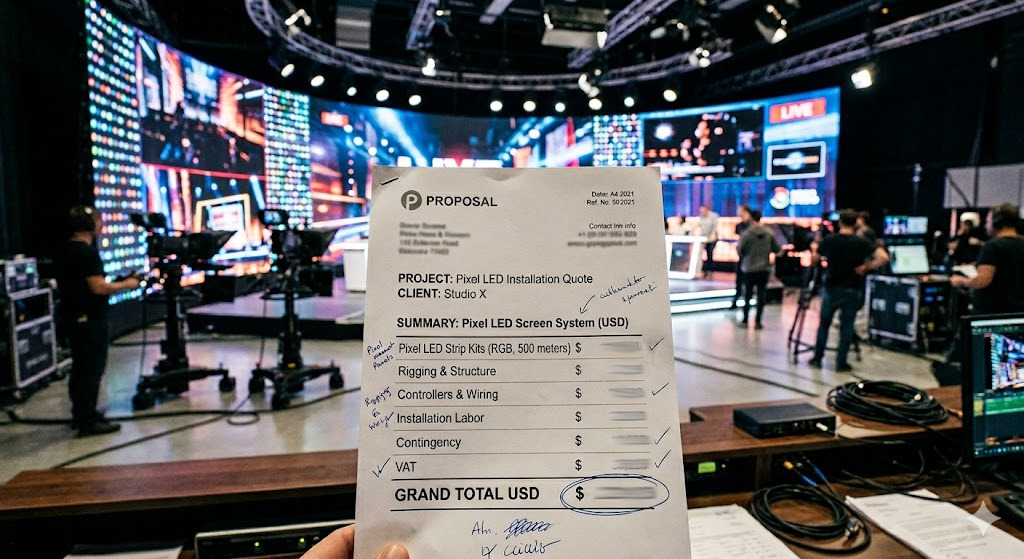
This calculator provides a rough cost estimate. When preparing a final quotation for your client, you should also consider the following expenses:
- Travel costs – Unless you can teleport, getting to the installation site costs money.
- Accommodation costs – Hotels can become a significant expense, especially for multi-day projects.
- Cabling – Include both power and signal cables required for the installation.
- Signal splitters – Devices such as the SPI Lamp 2 can reduce cable runs and significantly lower installation time and labour costs.
- Aluminium profiles and mounting hardware – If your installation requires them, they should be included in the final price.
What’s the Size of the Installation? #
The scale of your project is the most critical starting point for your budget. The number of meters directly dictates the amount of power distribution and the number of control outputs required.
- Small (Less than 20m): Ideal for ambient room illumination, small bars, or standalone artistic features. These often utilize compact controllers like the Reactivo 2 or SPI LED Controller. The price typically is less than 1000 USD.
- Medium (20–100m): Standard for mid-sized music clubs or decorative studio sets. Installations in this range, such as a music bar renovation, often require professional-grade units like the LEC3 Lite or Standard. The price depends on the installation complexity, but it’s approximately less than 10000 USD.
- Large (Over 100m): Found in massive media facades, stadiums, or major TV studios. These high-density projects can span kilometers and require dozens of synchronized controllers and centralized rack rooms. The price depends on how many LED lights you plan to use and it’s typically more than 10000 USD.
Installation Time: The “Human Factor” #
In professional experience, the most expensive component of an installation is often human labor [Conversation History].
- The 1-Hour Rule: A reliable rule of thumb is that one meter of LED strip requires approximately one hour of labor to soldier, mount, and test.
- The Aluminum Profile Variable: If the design requires strips to be housed in aluminum profiles with precise 45-degree miter cuts for intersections, the labor time can easily double to two hours per meter.
- Regional Labor Rates: Budgeting must reflect local economies. A technician may cost $10 USD per hour in some regions, while professional rates in high-cost areas can exceed $50 USD per hour [Conversation History].
Important note: You can save a significant amount of money by using the right technology and planning the installation properly. At our company, we can usually prepare installation support materials much faster at our headquarters than on-site, reducing installation time and overall labour costs.
How Many Pixels per Meter Should You Use? #
Choosing the right pixel density can save between 30% and 50% on your total material cost [Conversation History].
- 30 LEDs/m: This density is approximately 30% cheaper than 60 LEDs/m because it reduces the cost of the strip itself and lowers the power requirements [541, Conversation History]. Most importantly, it saves money on hardware; fewer pixels mean you need fewer outputs and universes from your pixel controllers.
- 60 LEDs/m: While more expensive, this is the standard for high-resolution displays where smooth animations and video content are paramount.
Branded vs. “Cheap” Controllers #
It is tempting to source cheap Art-Net or SD card controllers from platforms like Amazon or Aliexpress, but this often leads to a “false economy”.
- The Support Gap: Cheap controllers typically offer non-existent technical support. If your tape is flickering or the network won’t connect, you are left to troubleshoot alone, which can consume hours of expensive technician time.
- The Setup Hurdle: Low-cost devices are often difficult to configure and require non-standard, proprietary software to generate SD card content.
- The Math of Value: If a technician spends just one additional hour trying to set up a complicated, unsupported controller, the cost of that labor could have paid for a branded professional controller (like an LEC3) that includes a lifetime software license and dedicated expert support.
By investing in ruggedized, tested hardware with a 5-year warranty, business owners ensure their installation stays operational 24/7 without the high cost of emergency repairs or specialized equipment like cherry pickers for maintenance.
How much does a basic pixel LED installation cost for a small bar or restaurant?
For a small setup under 20 meters — think accent lighting along a bar counter or a simple ceiling feature — you’re typically looking at under $1,000 USD for hardware including the strip, a compact controller, and a power supply. Labor adds on top of that depending on your local rates and how complex the mounting is. A simple straight run is much cheaper to install than something with precision-cut aluminum profiles and tight corners.
What's the biggest cost in a large pixel LED installation?
Labor is almost always the most expensive part. The rough rule of thumb is one hour of work per meter of LED strip, which adds up fast on large projects. If you’re using aluminum profiles with mitered cuts, double that to two hours per meter. For a 200-meter installation, that’s 200–400 hours of technician time. Smart planning — like doing prep work at the workshop rather than on-site — can cut those hours significantly.
Can I save money by using fewer LEDs per meter (30 LEDs/m instead of 60)?
Yes, and it’s a legitimate strategy. Going from 60 to 30 LEDs per meter can reduce material costs by 30–50% because you’re buying half the LEDs, using smaller power supplies, and needing fewer controller channels. At viewing distances over a few meters, 30 LED/m often looks nearly as smooth as 60 LED/m. The tradeoff is reduced detail in close-up viewing situations. It’s worth discussing with your installer before you commit to a density.
Why are cheap controllers from Amazon a bad idea for professional installations?
The hardware cost savings disappear the moment something goes wrong. Cheap controllers have no real technical support, non-standard software, and no documentation in English. When a technician spends two or three hours debugging an unresponsive no-name controller, that labor cost alone exceeds the price difference between it and a professional unit. Branded controllers like the LEC3 come with direct support from the manufacturer, full documentation, and a 5-year warranty.
What costs are often forgotten when budgeting an LED installation?
Travel and accommodation are the big ones that people underestimate on out-of-town jobs. Beyond that: signal extenders (SPI Lamp, Symmetrizer) for large venues, aluminum profiles and mounting hardware, custom cable fabrication, network switches for multi-controller setups, commissioning time for software configuration and staff training, and a contingency of 10–20% for surprises. Always get these into the budget upfront rather than absorbing them as losses at the end.