
Which One Do You Actually Need? #
The world of addressable LED pixel strips is huge. On one end you have a $5 Arduino Nano driving 10 LEDs on your desk. On the other end, a rack-mounted LED pixel controller running 100,000 WS2811 pixels across a TV studio set. Both are doing the same basic job — sending SPI data to chips — but they’re not interchangeable. Knowing which tool fits your project saves you money, time, and a lot of frustration.
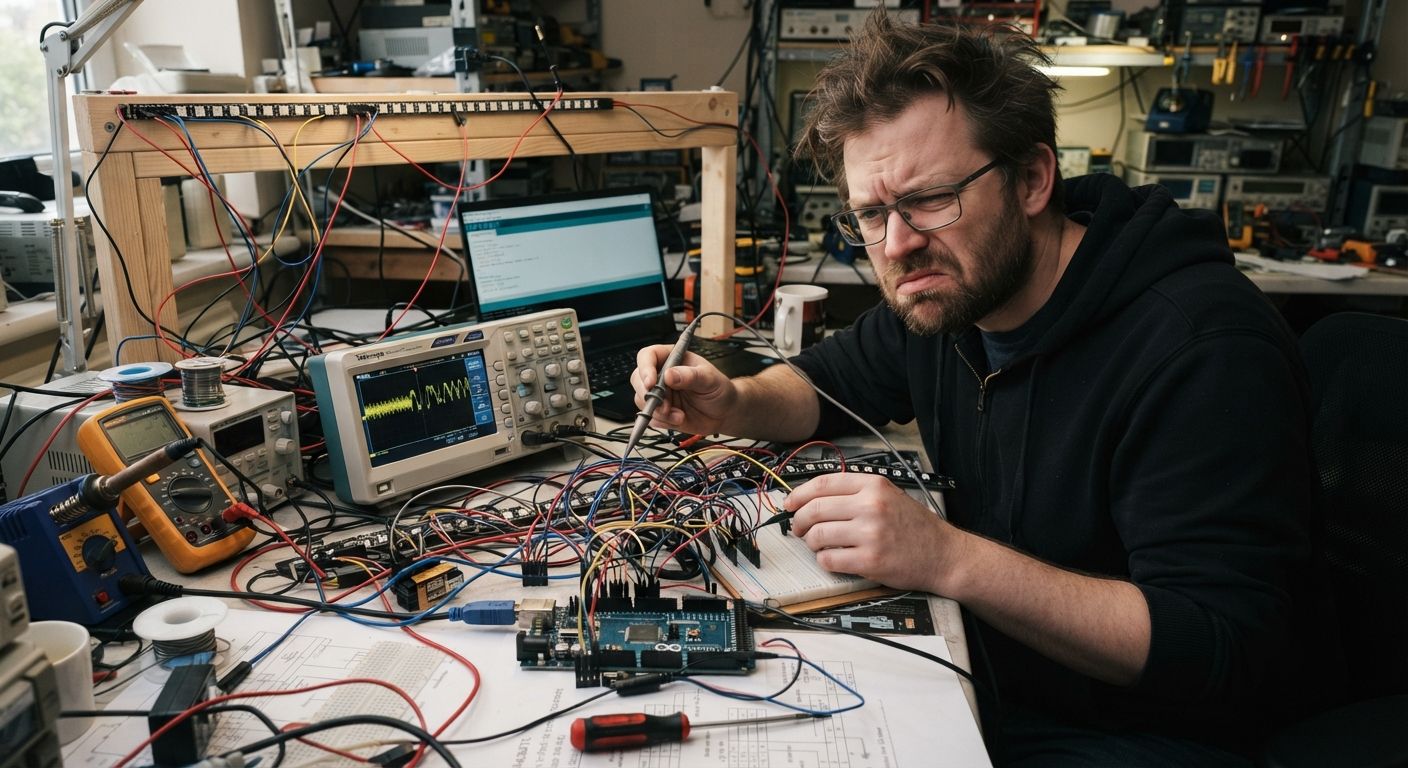
Is Arduino or WLED the Right Choice for Your Project? #
Arduino and WLED are genuinely great tools — for the right job. An Arduino is essentially a tiny computer you can program to drive a small string of addressable LEDs. Flashing an ESP32 module with WLED gives you a full web interface, mobile app control, and a library of built-in effects without writing a single line of code. For a lot of people, that’s exactly what they need.
Arduino makes sense when you are:
- A student or maker learning how pixel ICs like WS2812B or SK6812 actually work at a signal level
- Prototyping a concept before committing to a full installation
- Building a micro-scale project — a desk lamp, a holiday decoration, a costume piece — with fewer than 100 to 200 pixels
WLED on an ESP32 makes sense when you are:
- Setting up a simple home ambient installation like a TV backlight or bedroom ceiling strip
- Running basic patterns — fades, color chases, rainbow cycles — that don’t require frame-accurate synchronization
- Working on a residential LED installation where the occasional reboot or Wi-Fi dropout is a minor inconvenience, not a crisis
Both options keep your upfront hardware cost extremely low. For hobbyists and students, that’s often the deciding factor, and there’s nothing wrong with that.
Where Do DIY Solutions Start to Fall Apart? #
The problems with Arduino and WLED don’t show up on your desk. They show up on-site, at scale, under pressure.
Processing power runs out fast. An Arduino struggles once you push past a few hundred DMX channels. A professional DMX pixel controller or Art-Net LED controller uses a purpose-built processor — like the one inside the LEC3 — designed to push hundreds of frames per second to thousands of pixels simultaneously. When your digital LED strip installation spans an entire nightclub ceiling with 20,000 pixels, there’s no DIY alternative that comes close.
WLED and Art-Net don’t always mix well. WLED does support Art-Net input, but it’s receiving uncompressed data over Wi-Fi — a standard 2.4GHz network saturates quickly. The LED Strip Studio system solves this with a custom real-time data compression protocol that cuts network usage by roughly 80%, making wireless performance far more stable. If you’ve ever seen pixel LEDs glitch out on a busy event Wi-Fi, you’ve seen this problem firsthand.
There is no hardware protection in a DIY setup. Professional controllers like the LEC3 include smart electronic fusing, live voltage and current monitoring, and electrical fault isolation. A short circuit in a 12V addressable LED strip connected to a bare ESP32 board can take out the microcontroller, the strip, and potentially more. In a permanent commercial installation, that kind of failure means emergency service calls and downtime. In a nightclub or TV studio, that’s an unacceptable risk.
Signal distance is a real constraint. TTL SPI signals from an Arduino or ESP32 start degrading after about 3 meters of cable. A professional system uses differential signal buffers — like The Symmetrizer — to carry SPI data over 500 meters or more. That’s the difference between wiring a bedroom and wiring a building facade LED installation or a LED ceiling installation across a large venue.
What Makes a Professional LED Pixel Controller Worth the Investment? #
The price difference between an ESP32 module and a professional addressable LED controller can look dramatic on a spec sheet. But when you account for what you actually get, the math changes.
Reliability and warranty matter more than you think. Professional-grade controllers are built for 24/7 operation in demanding environments — the heat of stage lighting rigs, the vibration of speaker stacks, the humidity of outdoor events. LED Strip Studio controllers come with an industry-leading five-year warranty. That’s not a feature you’ll find on an AliExpress ESP32 board.
LED pixel mapping software is included. The LEC3 ships with a lifetime license for LED pixel mapping software that handles complex installation shapes, Bezier curves, irregular grids, and 100,000-plus pixels from a single interface. Replicating that capability with open-source tools takes significant setup time — and the results are rarely as clean.
Standalone operation means no PC required. For a standalone LED controller running a bar or hotel lobby, the system loads animations from an industrial SD card and runs them autonomously — triggered by sensors, physical buttons, timers, or LED pixel HTTP trigger commands from a smart building system. WLED offers some standalone functionality, but it’s not designed for mission-critical deployments.
Compatibility across IC types is guaranteed. Professional controllers explicitly support WS2811, WS2812B, WS2815, SK6812, APA102, TM1803, MBI6024, and other chip families out of the box. You get tested, reliable output — not community forum workarounds.
The Hidden Cost of “Saving Money” on Controllers #
Here’s something that comes up constantly in professional LED pixel installation work: a technician who spends one extra hour on-site troubleshooting a flaky DIY module has already spent more in labor than the cost difference between that module and a professional controller. Multiply that by multiple service calls, and the “cheap” option becomes the expensive option very quickly.
This is especially true for commercial LED installation work — nightclub LED installations, TV studio LED lighting, event stage LED lighting, hotel LED lighting installations. The client expects the show to work, every time, without a technician standing by. A professional plug and play LED system with factory support and a warranty delivers that. A DIY module does not.
Why Installation Cost Is Where DIY Really Becomes Expensive #
In real-world projects, especially across the 1000+ installations we’ve delivered, the biggest line item is almost never hardware — it’s installation time. This is where Arduino and WLED setups quietly become expensive. What looks like a low-cost controller on paper often requires a skilled programmer or system designer on-site to debug timing issues, network instability, power injection problems, or unexpected compatibility quirks between strips, firmware, and signal chains. Each extra hour spent troubleshooting is not just technical overhead — it’s direct labor cost at professional rates, multiplied across setup, testing, and maintenance visits.
In contrast, a professional LED pixel controller system is engineered for predictable deployment: pre-tested outputs, stable protocols, and consistent behavior across large-scale installations. That means fewer on-site surprises, faster commissioning, and dramatically lower installation hours — which, in commercial LED work, is where the real budget is won or lost.
The Simple Way to Decide #
If your project is personal, small, and low-stakes — Arduino and WLED are excellent. They’re also a fantastic way to learn how SPI protocol LED control actually works before stepping up to professional gear.
If your project is permanent, large, visible, or commercial — and especially if someone is paying you to deliver a result — a dedicated LED Strip Studio controller is the right call. The LEC3, the REACTIVO, or an Art-Net to SPI converter from a professional ecosystem gives you the processing power, protection, support, and software to deliver a reliable pixel LED installation that holds up for years.
The technology gap between DIY and professional has narrowed. The reliability gap has not.
WLED / Arduino vs Professional LED Pixel Controller Comparison #
| Category | WLED / Arduino (DIY) | Professional Pixel Controller |
|---|---|---|
| Target Use Case | Hobby, prototypes, small installations | Commercial, stage, TV, large-scale installations |
| Setup Complexity | High (manual wiring, firmware, tuning) | Low (pre-configured, plug-and-play workflows) |
| Scalability | Limited (hundreds to few thousand pixels depending on setup) | Very high (tens of thousands to 100k+ pixels per system) |
| Processing Power | Limited MCU resources (ESP32 / Arduino) | Dedicated hardware processors optimized for real-time pixel output |
| Network Stability | Wi-Fi dependent, prone to congestion | Wired Ethernet / optimized protocols (Art-Net/sACN + proprietary options) |
| Latency & Sync | Variable, not frame-accurate under load | Frame-accurate synchronization across large installations |
| Reliability | Community-supported, no guaranteed uptime | Industrial-grade, designed for 24/7 operation |
| Fault Protection | Minimal or none | Built-in protection (fuses, current monitoring, isolation) |
| Signal Distance | Very short (≈2–3 m without boosters) | Long-distance support (hundreds of meters via differential systems) |
| Software Ecosystem | WLED UI, open-source tools | Professional pixel mapping software + advanced control systems |
| Pixel Mapping | Basic or community plugins | Advanced mapping (curves, complex geometry, multi-universe control) |
| Installation Speed | Slow for large systems (manual tuning required) | Fast deployment (pre-tested workflows, standardized setup) |
| Maintenance | Higher (manual debugging, firmware issues) | Lower (diagnostics, monitoring, support tools) |
| Cost Structure | Low hardware cost, high labor cost | Higher hardware cost, lower installation & labor cost |
| Failure Impact | Higher risk of downtime or glitches | Designed for mission-critical environments |
| Best Fit | Learning, DIY projects, home lighting | Nightclubs, TV studios, festivals, architectural lighting |
| Support | Client forums, God’s mercy | Phone, email, WhatsApp, Zoom calls, … |
Can I use WLED to control a large nightclub LED installation?
WLED works well for small home setups, but it has real limits at scale. It struggles with large pixel counts, has no hardware fault protection, and its Wi-Fi Art-Net reception is prone to glitching on busy networks. For a permanent nightclub LED installation with thousands of pixels, a professional Art-Net LED controller with dedicated processing power and hardware fusing is the right choice.
How many pixels can an Arduino or ESP32 actually handle?
An Arduino Uno can reliably drive around 500 WS2812B pixels at 30fps before hitting processing limits. An ESP32 running WLED performs better — up to a few thousand pixels — but refresh rates drop significantly at higher pixel counts, and network latency adds up. Professional LED pixel controllers handle 100,000+ pixels with smooth, frame-accurate output because they use purpose-built processors and optimized hardware pipelines.
Is WLED good enough for Art-Net input from Resolume or Madrix?
WLED does accept Art-Net input, and it works in small setups. The issue is that it receives uncompressed Art-Net over Wi-Fi — which saturates a standard network quickly when driving many universes. Professional Art-Net pixel controllers use wired Ethernet and, in the case of LED Strip Studio, a real-time compression protocol that reduces bandwidth by about 80%. For professional use with Resolume Arena or Madrix, a dedicated Art-Net LED controller is much more reliable.
What's the difference between a DIY LED controller and the LEC3?
The LEC3 is a professional-grade Art-Net and SPI LED controller with smart electronic fusing, voltage and current monitoring, a dedicated Mk3 processor for high frame rates, and a lifetime license for LED pixel mapping software. It supports all major IC types — WS2811, WS2812B, WS2815, SK6812, APA102, and more — and includes a five-year warranty. A DIY ESP32 or Arduino board has none of these features and is not designed for permanent or commercial installations.
Can I extend SPI signals from an ESP32 over long cable runs?
Standard TTL SPI output from an ESP32 or Arduino reliably travels about 3 meters before signal degradation causes pixel glitches. Professional installations use differential signal buffers — like the LED Strip Studio Symmetrizer — to extend clean SPI data over 500 meters or more. This is essential for any large venue, building facade, or stage installation where controllers can’t be placed right next to the strips.
When does it actually make financial sense to use a professional controller instead of WLED?
As soon as labor cost enters the picture. If you or a technician spend even one extra hour on-site troubleshooting a DIY controller, the labor cost typically exceeds the price difference between the DIY board and a professional LED Strip Studio controller. For any commercial LED installation — a bar, hotel, TV studio, or event stage — the reliability, warranty, and technical support of professional gear pay for themselves quickly. For a personal bedroom project with 200 pixels and no time pressure, WLED is perfectly fine.