
In professional pixel LED installations, working with aluminum profiles is often a critical requirement because “naked” LED strips are generally considered aesthetically unpleasing . While some designers may appreciate a raw industrial look, it is widely regarded as unprofessional to have individual LED diodes visible to the human eye . Aluminum profiles provide a structured, polished finish that transforms a simple light source into a high-end architectural element.
Smoothing Visuals with Diffusers #
The primary reason to use aluminum profiles is to pair them with diffusers. These covers serve to hide individual LED pixels, making colors appear significantly smoother and more continuous to the viewer .
For standard 60 LEDs/m strips, achieving a perfectly uniform “neon” look requires a specific physical setup: you generally need a distance of at least 3cm between the aluminum base where the strip sits and the diffuser cover . Without this depth, the light will still appear “dotty” . However, some specialized projects utilize ultra-thin profiles combined with COB (Chip on Board) LED technology to achieve a dot-free look even without the 3cm depth.
Understanding the Trade-offs of Diffusion #
While diffusers improve the smoothness of the light, they introduce several technical challenges:
- Color Shifting: Diffusers typically shift colors slightly toward the white spectrum . For example, a vibrant red might appear as a “white-red” or pinkish tone through a standard milky cover .
- Daytime Visibility: Standard white diffusers remain highly visible even when the lights are off because they reflect surrounding ambient light .
- Brightness Loss: For a high-contrast “stealth” look, black diffusers can be used . While they look excellent and maintain high contrast, they typically cause a 60% to 80% loss in brightness . In such cases, designers often install double LED strips in every segment to compensate for the lost light intensity.
Structural Challenges and Geometry #
Aluminum is a rigid material, which dictates the types of shapes you can create:
- Approximating Curves: Aluminum cannot be bent like Neon Flex . If your design requires arcs or circles, you must approximate these shapes using short, straight segments .
- Complex 3D Angles: Installing profiles in three-dimensional space is extremely demanding . For instance, fitting a profile that crosses the corner of a wall at a non-perpendicular angle is a “new level of hell” because it is nearly impossible to calculate and saw the exact miter angles required for a perfect fit .
- Weight and Support: While aluminum is relatively lightweight, large standalone shapes will eventually bend under their own weight . To maintain structural integrity for larger designs, it is standard practice to install an aluminum support rope every 1 meter .
Production Logistics #
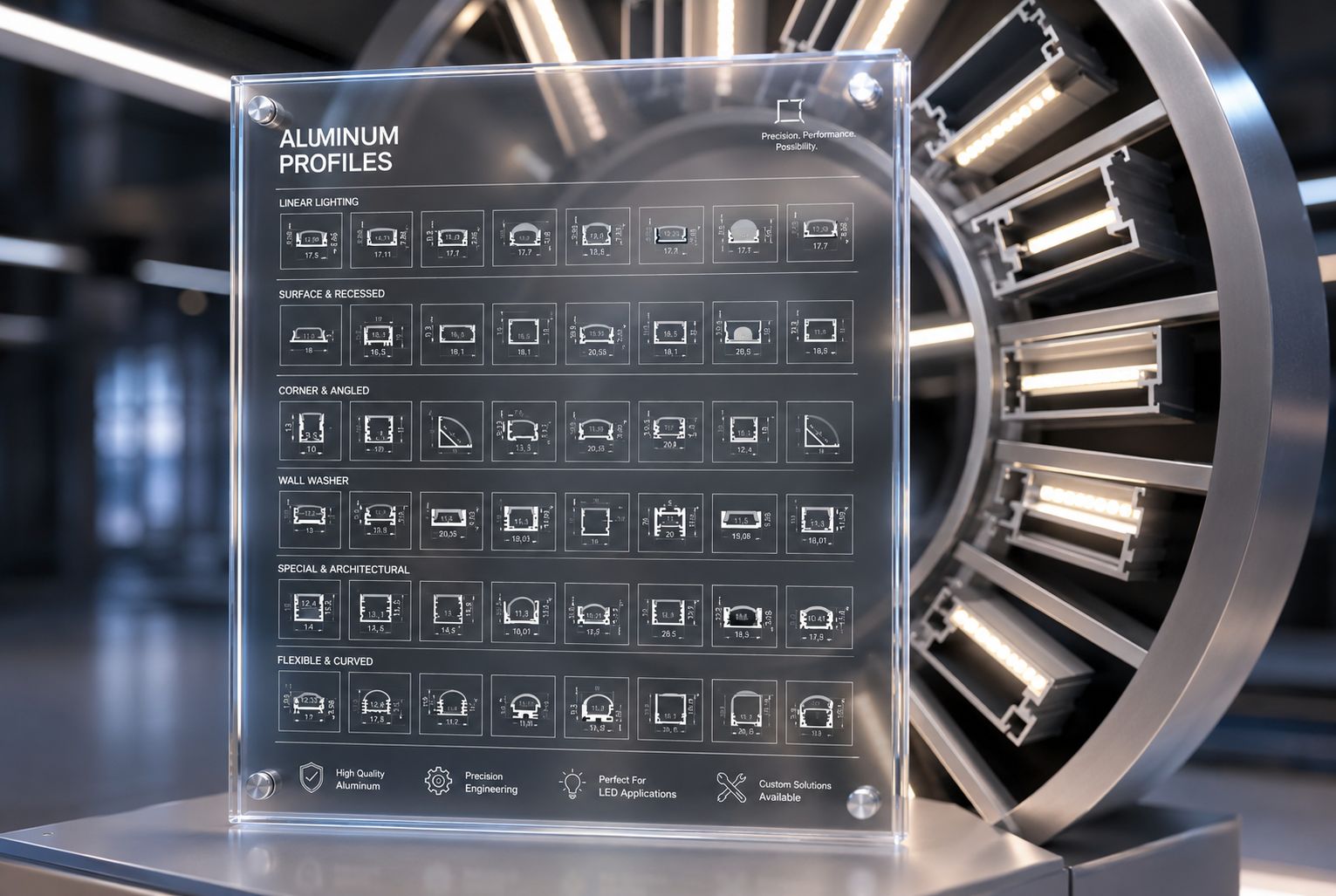
The availability of materials is a major factor in project timelines. There are over 100 different types of aluminum profiles, and it is rare for suppliers to have every variety in stock . This often prolongs production because the installation cannot begin until the specific aluminum required has been manufactured and delivered .
Thermal Management #
A common benefit cited for aluminum is its ability to act as a heat sink, cooling the strips and extending their lifespan . However, in practice, this benefit is often minimized because strips are frequently installed inside silicone covers for protection, which acts as an insulator . Fortunately, industry-standard professional strips like the WS2815 generally do not require significant cooling for stable operation .
Precision Preparation #
For the most efficient installation, it is best to determine the exact lengths of the profiles in advance . Preparing and cutting profiles in a controlled workshop environment is much faster and more accurate than making adjustments on-site .
Note for planning: While a standard meter of pixel strip typically takes one hour to install, the addition of aluminum profiles that require precision sawing increases the estimated labor to two hours per meter .
Do I really need aluminum profiles for LED strips, or can I just stick them to the wall?
You can stick them directly, but bare LED strips look pretty raw — individual diodes are visible and the result often looks cheap. Aluminum profiles with diffuser covers give a clean, finished appearance and hide the individual pixels into a smooth continuous light line. For any professional or commercial installation, profiles are almost always expected. They also protect the strip from physical damage and help with heat dissipation.
How do I get a smooth neon-like look with LED strips in a profile?
You need at least 3cm of depth between the LED strip and the diffuser cover. At less than that, individual LED hot-spots stay visible through the diffuser. For 60 LED/m strips this is especially important — at closer distances the dots show. If you’re tight on space, COB (Chip on Board) LED strips are designed to look dot-free even in very shallow profiles.
Why do my LED colors look a bit washed out or pinkish through the diffuser?
Standard milky/frosted diffusers shift colors slightly toward white — a vibrant red can become a pale pink through certain cover materials. If color accuracy matters for your project, test your diffuser material with the actual strip before committing to the full installation. Black diffusers give higher color contrast but absorb 60–80% of the brightness, so you’d typically compensate by doubling up the LED strips.
Can aluminum profiles be bent into curves for round shapes?
Aluminum profiles can’t be bent without special equipment — they’re rigid by nature. To create curved shapes you have to approximate them with short straight segments, which works fine for gentle curves at a distance but can look faceted up close. For true curves and organic shapes, LED neon flex (silicone extrusions) is the right material — it bends easily and maintains a smooth diffused appearance.
How long does it take to source aluminum profiles for a project?
There are over 100 different profile types and most suppliers only stock a fraction of them. Custom or unusual profiles are typically made to order and can take 4 weeks or more to arrive. Plan your profile selection early in the project and order as soon as the design is confirmed — waiting until the last minute for profiles is one of the most common causes of installation delays.