
The WS2815 is now the most widely used addressable LED strip in professional LED pixel installations. If you’ve been to a nightclub, walked past a lit-up building facade, or watched a TV show with dynamic LED backgrounds in the last few years, there’s a good chance WS2815 strips were behind the look.
It didn’t get there by accident. The WS2815 solves two problems that made earlier digital LED strips frustrating to work with at scale: voltage drop and signal failure. Those two fixes changed everything for professional installers.
Why Does Running on 12V Matter So Much? #
Older strips like the WS2812B LED strip run on 5V. That low voltage sounds efficient on paper, but it creates a real headache on longer runs — voltage drop. The further the electricity travels down the strip, the weaker it gets. LEDs at the end of a 5V run go dim or shift in color, and you have to inject power every 2–5 meters to compensate. That means more wire, more connectors, more labor, more failure points.
The WS2815 runs on 12V DC. The higher voltage gives it much more headroom to fight off drop. You can often run up to 10 meters before needing your first power injection point. For a professional LED pixel installation in a large venue or on a building facade, that’s a massive difference — fewer injection points means a cleaner, faster, less expensive install.
The pixel’s internal chip drops the 12V down to 5V for its own logic, so the IC still operates at the correct voltage. You get the run length of a 12V system with the pixel precision of the addressable protocol.
What Happens if One Pixel Burns Out? #
This is where the WS2815 really separates itself from older addressable RGB LED strips.
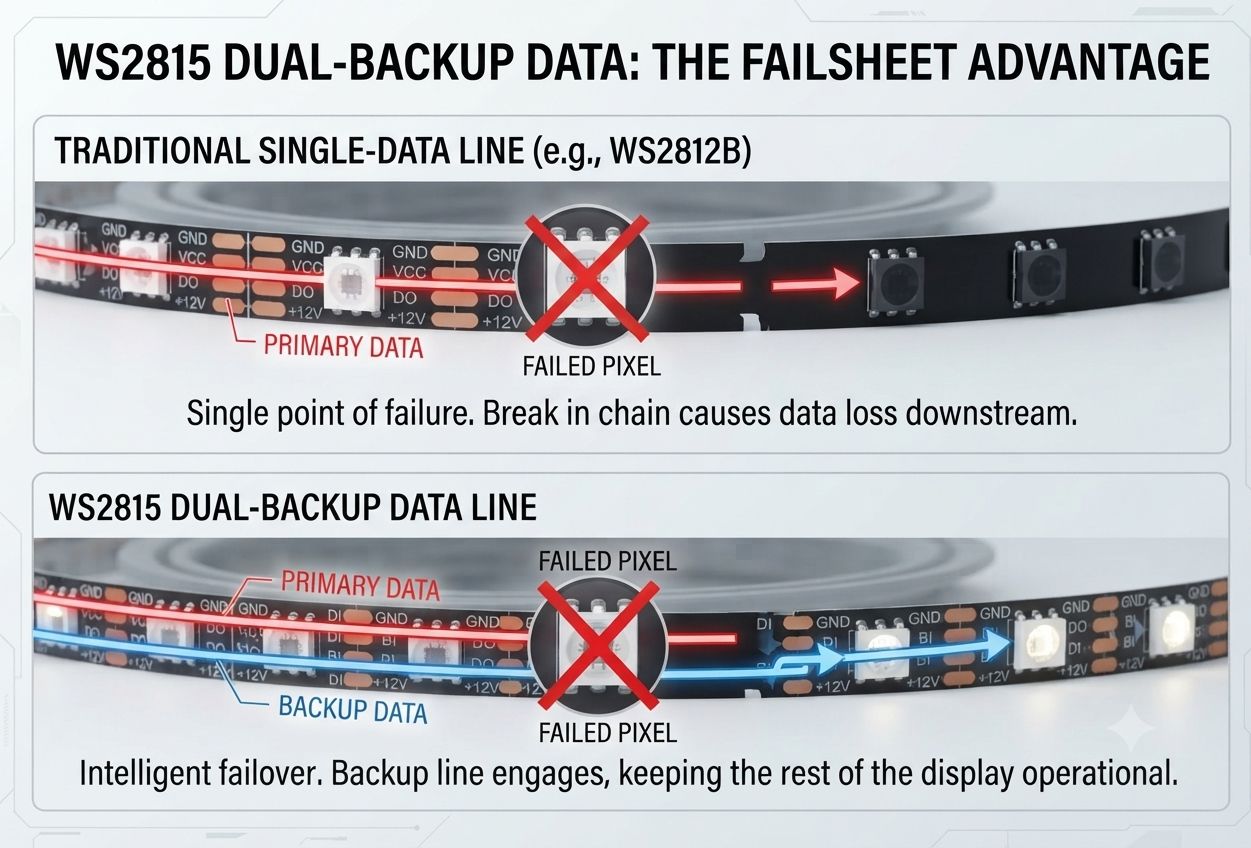
Traditional SPI addressable LED strips use a single data line. Each pixel passes the signal to the next one in the chain. If one pixel dies or gets physically damaged, it breaks the chain — everything downstream goes dark. On a 10-meter LED pixel wall or a LED pixel curtain in a club, losing half your display mid-show is not an option.
The WS2815 has a dual backup data line. There’s a primary data wire and a secondary backup wire running in parallel. If a pixel dies, the chip in the next pixel automatically reads from the backup line and keeps passing the signal forward. The rest of the strip stays on. For 24/7 commercial installations and live events, this failsafe behavior is non-negotiable.
Does Build Quality Actually Make a Difference? #
Yes — and the difference shows up months or years into the installation, not on day one.
The WS2815 uses an SMD 5050 LED package. Inside that tiny package, there are wire bonds connecting the LED chip to its contacts. Budget-grade strips use copper or alloy wires for those bonds. Professional-grade WS2815 strips use gold wire bonds instead. Gold doesn’t oxidize, conducts more reliably under heat, and holds up under the thermal stress of continuous operation.
When you’re specifying a pixel LED installation that needs to run reliably for its full 50,000-hour rated lifespan — in a TV studio, a hotel lobby, or an outdoor LED facade — the internal wire material matters. Gold wire versions cost a bit more. They’re worth it.
Is the WS2815 Compatible with Professional Controllers? #
Yes, and that’s another reason it’s become the default choice. Because the WS2815 is so widely adopted, every major professional pixel LED controller supports it out of the box.
That includes the LED Strip Studio LEC3, SPI Matrix, Reactivo, and essentially every other Art-Net LED controller or SPI LED controller on the market. You won’t run into compatibility issues. It’s listed as a supported IC in every serious LED pixel control software platform — including LED Strip Studio software, MadMapper, and Resolume Arena.
The strip is available in 30 or 60 LEDs per meter density. 30 LEDs/m gives you cost-effective coverage for large surfaces. 60 LEDs/m gives you higher visual resolution for close-up LED pixel wall and LED video wall installation work.
What’s the PWM Rate — Will It Flicker on Camera? #
The WS2815 runs at a 2000 Hz PWM rate. That’s fast enough to film without flicker at standard camera frame rates, including up to 67fps. For TV studio LED lighting, LED lighting for TV shows, and event stage LED lighting, this matters a lot. Cheaper strips with lower PWM rates produce visible banding in video footage.
If your strip will ever be in front of a camera — on a set, at a concert, in a broadcast studio — make sure you’re specifying a strip with a high PWM rate. The WS2815 clears that bar comfortably.
Where Is the WS2815 Used in Real Installations? #
The WS2815’s combination of long run capability, failsafe signal, and camera-friendly performance makes it the right choice for a wide range of professional projects.
Nightclub and bar LED installations use it because the strips need to run all night, every night, and a dead pixel mid-show is unacceptable. TV studio LED lighting and LED lighting for TV shows rely on it for flicker-free camera performance. Architectural LED lighting and LED building facade lighting projects choose it because outdoor runs are long and power injection points are expensive to add after the fact. Hotel LED lighting installations and restaurant LED installations use it for the longevity and low maintenance of the failsafe design.
For outdoor LED pixel installations, the WS2815 is commonly available in IP67 LED strip variants with full waterproofing — rated for rain, humidity, and temperature swings.

How Does the WS2815 Compare to Other Strips? #
WS2815 vs WS2812B: The WS2812B is 5V, single data line, no backup. It’s fine for small hobby projects. For any professional job, the WS2815 is a clear step up in every practical dimension.
WS2815 vs WS2811 LED strip: The WS2811 is also 12V but controls LEDs in groups of three rather than individually. The WS2815 gives you individual pixel control at 12V — a better option for high-resolution pixel mapping work.
WS2815 vs SK6812 LED strip: The SK6812 is popular for its RGBW variant (SK6812 RGBW strip adds a white channel). If you need a dedicated white LED for color accuracy, SK6812 RGBW is worth considering. For pure RGB with maximum reliability and run length, WS2815 is typically the stronger choice.
What makes the WS2815 better than the WS2812B?
The WS2812B runs on 5V, which causes serious voltage drop on longer runs and requires power injection every 2–5 meters. The WS2815 runs on 12V, so you can go up to 10 meters between injection points. It also has a dual backup data line — if one pixel dies, the rest of the strip stays on. The WS2812B has no backup line, so one dead pixel kills everything downstream. For any professional installation, the WS2815 is the better choice.
How far can I run a WS2815 strip without injecting power?
It depends on the density and brightness level, but as a general rule you can run up to 10 meters at full brightness before voltage drop starts affecting color accuracy. At reduced brightness or lower densities (30 LEDs/m), you can often go further. Always calculate your total current draw and consult a voltage drop calculator for your specific setup — but compared to 5V strips that need injection every 2–5 meters, the WS2815 gives you a lot more flexibility.
Will WS2815 strips flicker on camera?
No — the WS2815 runs at a 2000 Hz PWM rate, which is fast enough to avoid flicker at camera frame rates up to 67fps. This makes it a solid choice for TV studio LED lighting, broadcast sets, and concert stage work where cameras are always rolling. Cheaper strips with lower PWM rates (around 400–800 Hz) will produce visible banding in video. If your install will be filmed, always verify the PWM rate of the strip before buying.
What controllers work with the WS2815?
The WS2815 is supported by virtually every professional SPI LED controller and Art-Net LED controller on the market — including the LED Strip Studio LEC3, MADRIX NEBULA, Advatek PixLite Mk3, and dozens of others. It’s also natively supported in LED Strip Studio software, MadMapper, and Resolume Arena. Because it’s so widely adopted, compatibility is rarely a concern. Just select WS2815 from the IC type list in your controller’s configuration.
What's the difference between gold wire and standard WS2815 strips?
Inside each LED package, tiny wires bond the chip to its contacts. Budget strips use copper or alloy wires, which can oxidize over time and fail under the heat stress of continuous operation. Professional-grade WS2815 strips use gold wire bonds, which resist oxidation and stay reliable through the full rated lifespan of 50,000 hours. The price difference is small. For commercial installations where changing strips later is expensive, always specify gold wire.
Can WS2815 strips be used outdoors?
Yes. The WS2815 is widely available in IP67 waterproof versions with a silicone sleeve or potting that protects against rain, humidity, and dust. For outdoor facade lighting, architectural installations, or any outdoor LED pixel installation, make sure you specify the IP67 variant and pair it with a weatherproof power supply and sealed connectors. IP65 versions offer splash protection but aren’t rated for submersion — IP67 is the right choice for exposed outdoor environments.