
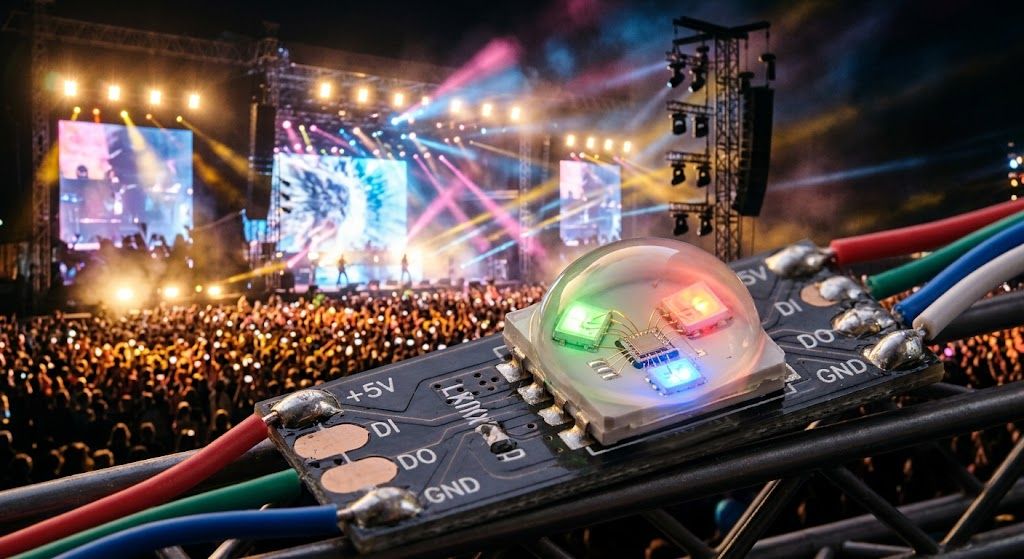
In the world of addressable lighting, the IC (Integrated Circuit) chip is the fundamental component that distinguishes a “digital” or “smart” LED strip from a traditional “dumb” analog strip. Often referred to as the “brain chip,” the IC is responsible for the precise, individual control of every point of light in an installation.
Core Functions of the IC Chip #
The IC chip acts as a local manager for the LED diode it is attached to. It performs several critical technical tasks:
- Individual Power Control: The IC regulates the electrical power for every color diode (Red, Green, Blue, and sometimes White) within the pixel. Unlike analog strips where the whole line reacts to power changes at once, the IC listens to a data feed to determine exactly how much power to deliver to its specific LEDs.
- Pulse Width Modulation (PWM): To control the intensity or brightness of each R, G, and B color, the IC chip utilizes PWM. This technique works by rapidly turning the LED on and off at high frequencies—so fast the human eye perceives it as a steady, dimmed light rather than a flicker. The ratio between the “on” time and “off” time determines the perceived brightness, allowing for millions of color combinations.
Communication via SPI Protocol #
For an IC to know what color to display, it must receive instructions through a data language known as SPI (Serial Peripheral Interface).
The mechanism is a “daisy-chain” process: the first IC in a strip listens to the incoming data stream, takes the instructions meant for its specific pixel (usually the first 3 or 4 channels), and then passes the remaining information to the next IC in the line. This allows thousands of pixels to be controlled from a single output on a controller like the LEC3 or Reactivo.
Important SPI Protocol Types #
There is no single industry standard for SPI; instead, there are various families of chips, each with its own timing and data requirements. Some of the most common include:
- WS Family: Extremely popular for budget and professional projects alike. Includes WS2811, WS2812B, and the WS2815, which is notable for having a backup data line to prevent the whole strip from failing if one pixel dies.
- TM Family: Often used in commercial displays, including TM1803, TM1804, TM1809, and the RGBW-capable TM1814.
- APA Family: High-speed protocols like APA102 and APA104. These are “clocked” protocols, meaning they use a separate wire for timing, which allows for much faster refresh rates and more stable data transmission over long distances.
- SK Family: Includes the SK6812 (often used for RGBW) and SK9822, which is a high-speed clocked alternative to the APA series.
DMX Control and Its Limitations #
While SPI is the primary language of the IC chip, it is possible to control addressable LEDs via the DMX512 protocol by using a DMX-to-SPI decoder. However, DMX has a significant physical limitation when used for high-density pixels:
- The 170 RGB Pixel Limit: A single DMX Universe consists of 512 data channels. Because one RGB pixel requires 3 channels (one each for Red, Green, and Blue), a single universe can only control 170 pixels ($512 \div 3 = 170$).
- The RGBW Constraint: If you use RGBW strips, which require 4 channels per pixel, the limit drops even further to just 128 pixels per universe.
Because modern installations often use thousands of LEDs, professional setups typically move away from standard DMX cables and instead use Art-Net or sACN over Ethernet, which can carry hundreds of universes simultaneously to the pixel controllers.
Internal vs. External ICs: Space, Quality, and Pixel Resolution #
In the addressable LED market, pixel control chips (ICs) come in two primary physical configurations: external and internal (integrated).
External ICs: Flexibility and Professional Quality #
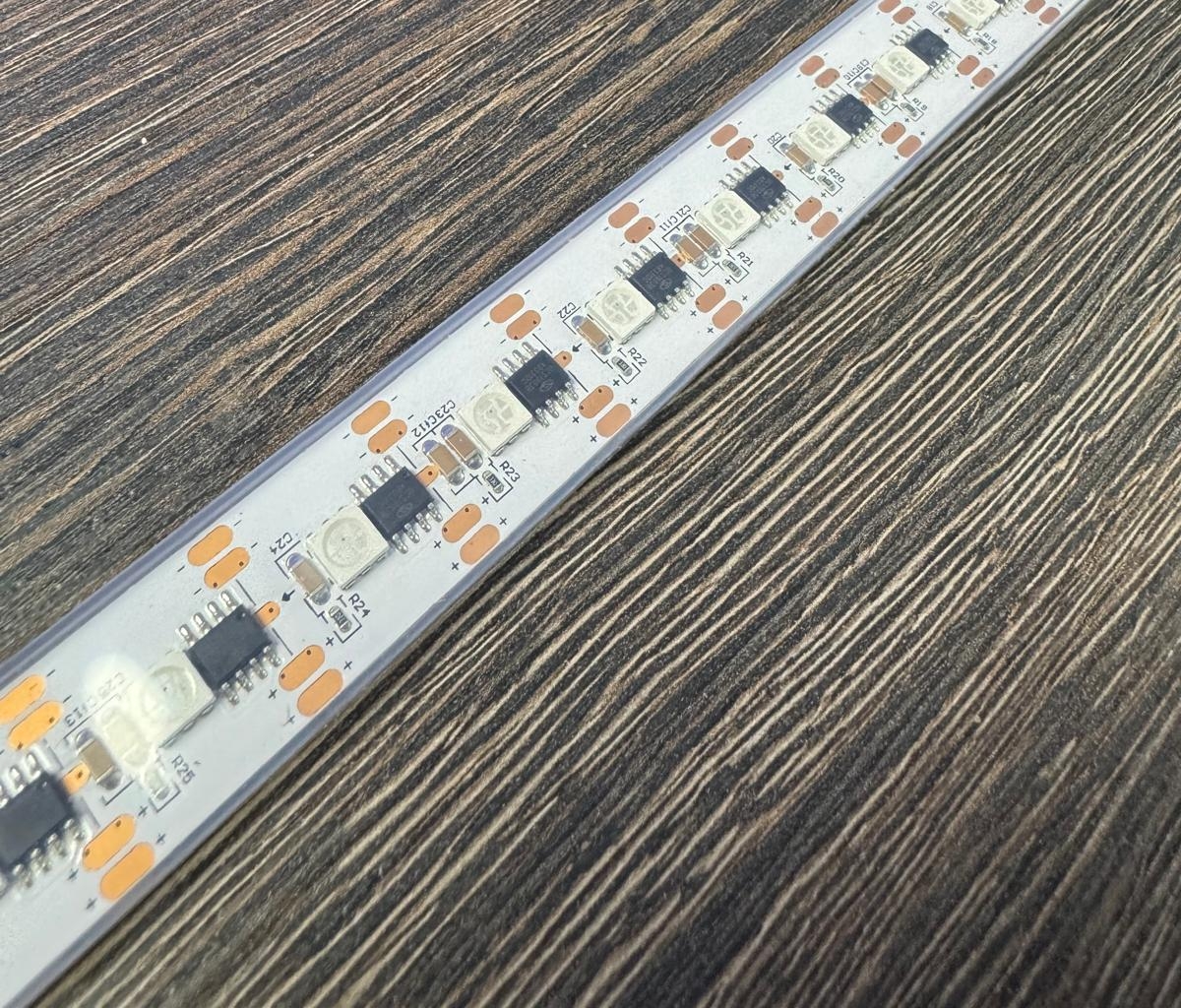
External ICs, such as those found in the WS2811, WS2801, or MY9231 families, are separate components mounted on the PCB or housed in molded casings alongside the LED diodes.
- Higher Component Quality: These chips are often associated with higher professional quality because they allow manufacturers more flexibility in selecting high-end LED emitters to pair with the controller.
- Advanced Specifications: High-performance external ICs like the MY9231 are larger physical chips that provide 16-bit color resolution and extremely fast PWM rates, making them ideal for high-end filming and broadcast environments.
- Space Constraints: Because these external chips require their own dedicated space on the circuit board, they are typically used in applications where the physical footprint is less restricted, such as molded pixel strings or lower-density strips.
Integrated ICs: Compact Design and High Resolution #
In contrast, internal or integrated ICs—pioneered by series like the WS2812B, SK6812, and APA102—conceal the driver “brain” and the RGB diodes within a single 5050 SMD package.
- Maximum Space Efficiency: By integrating the control circuit directly into the LED diode, these chips save a significant amount of space on the PCB board.
- Higher Pixel Resolution: This space-saving architecture is what allows for the creation of high-resolution LED strips, as it enables manufacturers to populate the board with a much higher density of pixels, reaching up to 144 LEDs per meter.
- Simplified Design: Integrated chips are popular for their simple design and small physical footprint, making them the standard choice for flexible PCB strips used in creative displays and interior accents.
Choosing the Right Architecture #
While external ICs offer superior flexibility and heat dissipation, integrated chips are the essential solution for projects requiring seamless, high-density visuals where board space is at a premium. For large-scale installations like media facades, designers may even use specialized long-range strips where groups of LEDs are controlled by a single external IC to save control channels across massive distances.
For example, we use an external driver IC in our ProfiLED products because rental LED bars are subjected to constant use, frequent transport, and much rougher handling than permanent installations. The external IC design provides higher reliability and durability, ensuring stable operation even in demanding rental environments.
What is the most widely used protocol/IC in pixel LED installations in 2026? #
The most commonly used solution is WS2815, and for good reason:
- 12V power supply – allows you to typically run power up to ~5 m from one end (with 60 LEDs/m strips), reducing voltage drop issues.
- Industry standard protocol – the WS281x family has become a de facto standard in many pixel LED installations.
- High installation flexibility – the strip can be cut after every LED, giving a precision of about 1.8 cm at 60 LEDs/m.
Why do some strips say "WS2812B" and others say "WS2815" — what's the practical difference?
Both are from the same WorldSemi family and use the same basic single-wire protocol. WS2812B runs at 5V with the IC integrated into the LED package — popular for DIY and short runs. WS2815 runs at 12V, which means less voltage drop over longer distances, and it has a second backup data wire so if one pixel chip dies, the rest of the strip keeps working. For permanent installations, WS2815 is usually the smarter choice.
What happens to my LED strip if one IC chip fails?
It depends on the strip type. With WS2812B, a failed IC chip breaks the data signal chain — all pixels downstream from the dead one go dark. With WS2815, the backup data line takes over automatically and only that one pixel goes dark. This is why WS2815 is strongly preferred for permanent installations where accessing and replacing a single LED in a finished ceiling or wall is a real pain.
What does PWM mean and why does it matter for LED strips?
PWM stands for Pulse Width Modulation — it’s how the IC chip controls brightness. Instead of reducing the actual voltage to the LED (which would change its color), the chip rapidly switches the LED on and off thousands of times per second. The ratio of on-time to off-time determines how bright it appears. Higher PWM frequencies mean smoother dimming and fewer flicker issues, especially when recorded on camera.
Can I mix different IC types in the same installation?
You can, but each group needs its own controller output configured to match that IC type. You can’t chain a WS2812B section directly to a WS2815 section and have them both work from the same output. In practice, most installers stick to one IC type throughout a project to keep things simple and avoid configuration headaches. If you genuinely need different ICs in one installation, use a controller with multiple independently configurable outputs like the LEC3.
What's the advantage of APA102 over WS2812B for video and broadcast work?
APA102 uses a separate clock wire which allows it to refresh much faster — we’re talking thousands of frames per second versus the 400Hz or so of WS2812B. This extra speed means you can capture APA102 strips on a high-frame-rate camera without seeing any flicker or rolling shutter artifacts. It also allows smoother dimming at low brightness levels. The tradeoff is an extra wire in the installation and slightly more complex controller setup.