
SPI Lamp is designed to speed up the installation process and eliminate repetitive tasks. Developed for pendant lights with LED pixels, it can significantly reduce the time spent on installation.
What is SPI Lamp? #
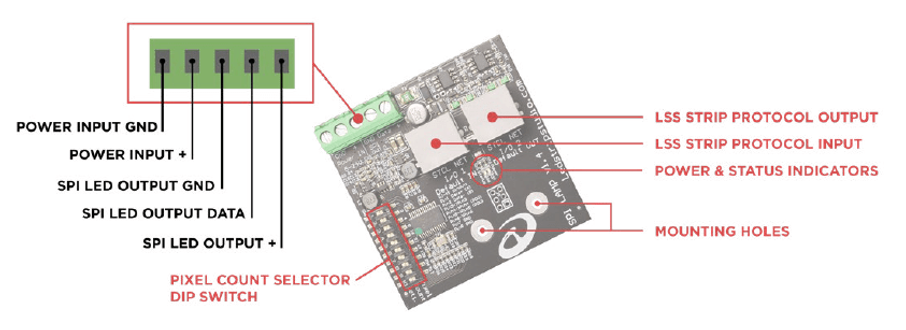
As a signal splitter, SPI Lamps allow you to connect strip segments in parallel without needing to connect the ends of the segments together, and also allow you to place strips far away (100 meters or more) from SPI Matrix / LEC3 controllers.
These benefits can be leveraged to a great extent in all types of projects. Whether it’s a rental job or a permanent installation.
No Need to Connect Segments #
One of the most repetitive and time-consuming tasks in any installation is the need to connect each segment to one another. With an SPI lamp, you only use connectors.
Long-distance data transmission #
Another major advantage is that you can disconnect your strip from the controller and place it 10, 20, or even 100 meters away from the controller without needing to use expensive cables. CAT5E or higher standard cables handle this perfectly.
How the SPI Lamp Works #
Another advantage of the SPI Lamp is that you can use it over long distances without worrying about signal loss, as it is highly resistant to interference. See the video below for details.
If you have any questions, please don’t hesitate to contact us.
How far can the SPI Lamp send an LED signal?
The SPI Lamp can reliably transmit the SPI signal 100 meters or more over standard Cat5e Ethernet cable. This means your LED strips can be placed far from the main controller without needing expensive specialized cable or worrying about signal degradation. It’s a major time-saver on large installations where running individual wires back to a central controller would be complicated.
Do I need to configure the SPI Lamp, or does it just work out of the box?
It’s essentially plug-and-play. You connect the SPI output from your controller to the SPI Lamp input, run Cat5e cable to wherever your strip is located, and connect the strip at the far end. The LED strip and controller don’t need any special configuration changes — they’re not aware the signal traveled over a differential link. No IP addresses, no software setup required.
Can I connect multiple LED strip segments to one SPI Lamp?
Yes — that’s one of the main benefits. As a signal splitter, the SPI Lamp lets you connect multiple strip segments in parallel from a single SPI output without needing to chain segments end-to-end. This eliminates the repetitive task of connecting segment endings together and makes the installation much cleaner and faster, especially for pendant light setups.
Is SPI Lamp compatible with all IC types like WS2812B and SK6812?
Yes, it supports all the major SPI pixel IC families including WS2812B, SK6812, WS2811, and TM1809. The differential transmission is transparent to the LED strip — the signal arrives at the strip in exactly the same format it left the controller. Just make sure your controller is configured correctly for the IC type on your strip, and the SPI Lamp takes care of the distance automatically.
Is SPI Lamp better for rental jobs or permanent installations?
It’s great for both, but for different reasons. In permanent installations the main benefit is architectural flexibility — you can position the controller in a tech room and run clean Cat5e cable to strips distributed throughout the building. For rental, it speeds up rigging significantly because you use standard Cat5e patch cables instead of custom SPI wiring harnesses, and segments can be positioned independently without daisy-chaining.