
One of the most common requests we get from clients is wireless signal transmission for their LED pixel installations. The need is clear — dance performances, theatrical productions, and installations on moving objects all make running a cable physically impossible. But the technical reality is more complicated than most people expect.
Can You Transmit SPI Wirelessly? #
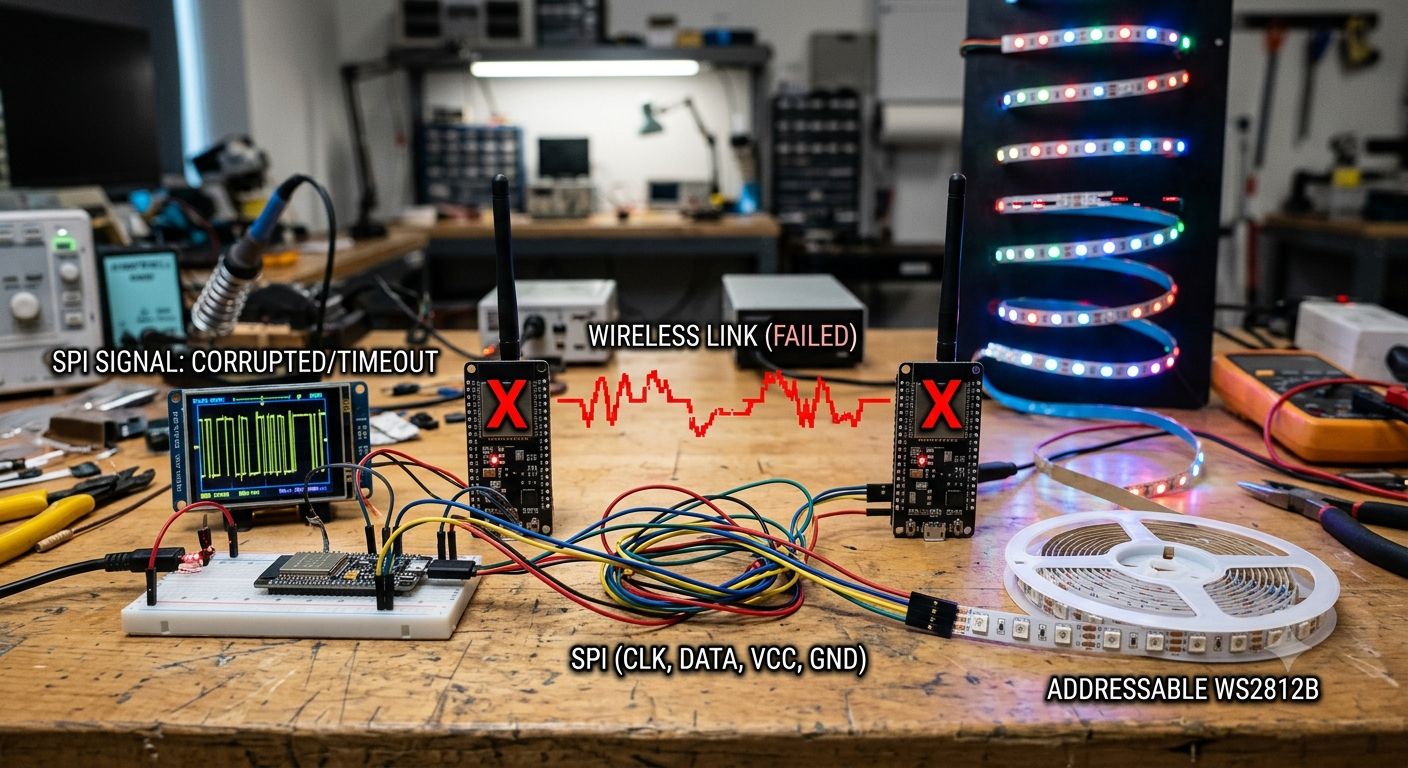
The short answer is no — not in any practical way.
The SPI signal (clock + data) that drives addressable LED strips like WS2811, WS2812B, or WS2815 is designed as a short-distance, high-speed wired interface. It has extremely tight timing requirements. Even a few microseconds of unpredictable wireless latency would corrupt the entire LED data stream. You’d see flickering, color glitches, or a completely frozen installation.
So transmitting raw SPI wirelessly is off the table. The question becomes: what signal can you transmit instead?
What About Standard Wi-Fi? #
Most modern pixel LED controllers are Ethernet-based — they receive Art-Net or sACN over a network connection. This opens the door to using a regular Wi-Fi network to transmit the signal between your control computer and your SPI pixel controller or Art-Net LED controller.
In theory, this works. In practice, it’s one of the biggest traps in professional LED pixel installation.
The problem is that standard Wi-Fi operates on the 2.4 GHz and 5 GHz bands — the exact same frequencies used by every iPhone, Android device, and wireless microphone in the venue. During rehearsals, your installation will run perfectly. The moment your audience walks in or the wireless mics go live, you lose packets. Frames drop. The show falls apart at exactly the wrong moment.
The Technical Reality: Latency and Sync #
Even if you could control interference, Wi-Fi introduces serious timing problems.
Wireless networks typically add around 80ms of latency compared to wired Ethernet. That might sound small, but in a live show, it means your wireless LED pixel segments appear visually “late” compared to your wired sections. Synchronization protocols like ArtSync or sACN Sync are notoriously unreliable over Wi-Fi — routers often reorder or silently drop sync packets, causing “tearing” where different controllers display content from different frames at the same time.
LED Strip Studio’s proprietary LSS protocol helps by compressing data in real time, saving around 80% of network bandwidth. This makes Wi-Fi performance more stable compared to raw Art-Net. But even with compression, larger installations push beyond what Wi-Fi can reliably handle.
The Only Reliable Option: DMX WiFi #
After years of working on LED costumes, dance performances, and theatrical pixel LED installations, the only wireless technology we’ve found that consistently works is dedicated DMX WiFi — hardware like LumenRadio.
DMX WiFi operates on a dedicated radio band, separate from consumer Wi-Fi. It’s designed specifically for live entertainment, with interference rejection built in. For dancers wearing analog LED costumes with RGB pixel strips, it’s a solid, proven solution.
A typical LED dance costume we build uses 16 independent body zones, each with its own RGB color control. One full costume uses around 50 DMX channels — 48 for RGB zones plus 2 extras, including an analog brightness channel that preserves full 255-step color depth even at lower intensities. With a standard 512-channel DMX universe, that’s up to 10 independent dancers controlled from a single DMX WiFi transmitter. That covers even large-scale event productions.
What About Large Pixel LED Costumes? #
Here’s where DMX WiFi hits its limit.
DMX WiFi carries 512 channels per universe — enough for 170 independent RGB pixels. For simple analog LED dance costumes, that’s fine. But our pixel LED dance costumes use over 2,000 individual addressable RGB LED pixels. To transmit the full pixel data for a single costume, you’d need at least 12 separate DMX WiFi transmitters running simultaneously. At that scale, the transmitters start interfering with each other, and the whole system becomes unmanageable.
Transmitting real-time pixel data for 2,000+ RGB pixels wirelessly is not practically feasible with any current technology.
How to Control Thousands of LED Pixels over Wi-Fi? #
This is where we use a different approach entirely — one that sidesteps the bandwidth problem completely.
The LEC3 LED controller and SPI Matrix Art-Net pixel controller both have built-in SD card slots. We export the entire video show or animation sequence directly onto an SD card. The pixel LED controller plays back the content locally, with no need for any live data stream.
Instead of transmitting pixel data wirelessly, we use DMX WiFi only to send trigger commands — “play show #1,” “play show #2,” “stop.” The bandwidth required for a single trigger command is negligible, and DMX WiFi handles it easily.
This approach completely eliminates the bandwidth problem. The wireless link only needs to carry a handful of control messages, not thousands of pixels of real-time data.
Solving the Sync Problem #
Even with SD card playback, one problem remains: synchronization.
If each dancer’s costume starts playing from the SD card at slightly different times — even by 80ms — it becomes visible. Costumes look mismatched. The choreography falls apart visually.
The solution we use is to transmit a sync signal over DMX WiFi. Rather than just triggering playback start, the controller receives ongoing sync packets that allow it to continuously re-align its playback position. If a packet is delayed or missed, the next correct packet corrects the timing. The costume stays locked in sync with the rest of the performance — even if individual wireless packets are occasionally late.
This combination of local SD card playback with wireless sync is currently the best method we know of for controlling large-scale pixel LED installations on moving objects or performers.
Is There a Better Way? #
Not yet.
Wi-Fi 7 promises higher throughput, but latency is still not guaranteed in real-world environments with interference. For live performances, you simply cannot afford dropped frames or a multi-second data gap. When a club visitor’s phone causes your LED pixel stage design to freeze mid-show, no amount of bandwidth solves the problem if the timing guarantee isn’t there.
DMX WiFi with SD card playback and wireless sync remains the most practical, battle-tested method for professional wireless pixel LED installation on costumes, moving theatrical props, or any application where a cable is not an option.
Can I use Art-Net over Wi-Fi to control LED pixels wirelessly?
Technically yes, but it’s unreliable for live events. Standard Wi-Fi shares bandwidth with phones and wireless microphones in the venue, which causes packet loss and frame drops at the worst possible times. Even in ideal conditions, Art-Net over Wi-Fi adds ~80ms of latency and makes sync protocols like ArtSync unreliable. For anything critical, avoid it.
What is the best wireless protocol for controlling LED dance costumes?
DMX WiFi (such as LumenRadio) is the most reliable option for LED dance performances. It operates on a dedicated radio band, separate from consumer Wi-Fi, and is designed to handle the interference found in live event environments. For analog LED costumes with RGB zones, 512 DMX channels is enough to control up to 10 independent dancers.
How do you control a pixel LED costume with over 2,000 addressable LEDs wirelessly?
You don’t transmit the pixel data wirelessly at all. Instead, export your full animation or video show to an SD card inside the LED controller (like the LEC3 or SPI Matrix). Then use DMX WiFi only to send trigger commands — “play show #1,” “start,” “stop.” This eliminates the bandwidth problem entirely while keeping the wireless link simple and reliable.
How do you keep multiple wireless LED costumes in sync?
The trick is to use DMX WiFi not just for triggering playback, but also for transmitting a continuous sync signal. Each controller uses incoming sync packets to continuously align its SD card playback position. If one packet is delayed, the next correct packet re-synchronizes the costume. This keeps all performers locked together even when individual wireless packets arrive late.
Why doesn't regular Wi-Fi work for live LED pixel shows?
Wi-Fi works fine during rehearsals when the venue is empty. Once the audience arrives with their phones, or wireless microphones go live, interference on the 2.4 GHz and 5 GHz bands causes packet loss. LED pixel controllers drop frames or lose the connection entirely. DMX WiFi avoids this by using a dedicated radio frequency designed for live entertainment.
Can you transmit an SPI signal wirelessly?
No — not in any practical way. SPI (the protocol used by WS2811, WS2812B, WS2815, and most addressable LED strips) requires precise timing with microsecond accuracy. Any wireless medium introduces unpredictable latency that corrupts the data stream. The correct approach is to transmit a higher-level control signal (like DMX) wirelessly, and handle the SPI conversion locally inside the LED pixel controller.