

Project Quick Facts
The Problem With Black Stage Fabric #
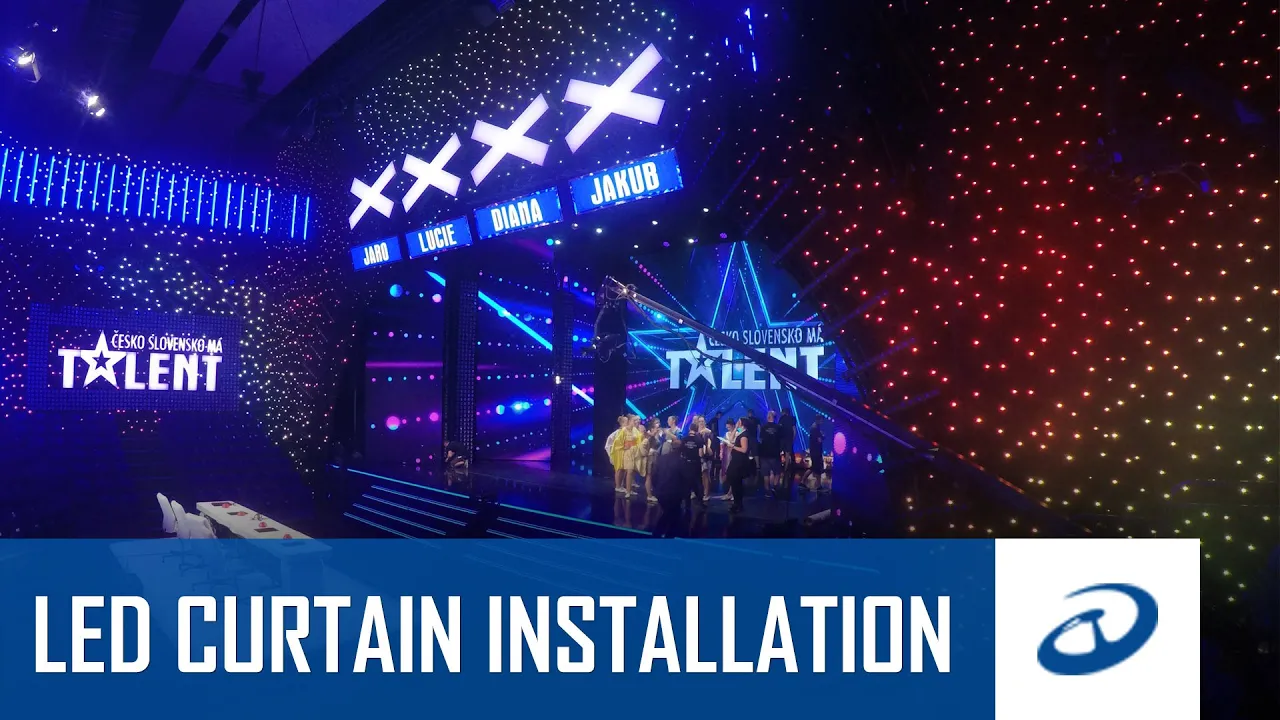
Czechoslovakia’s Got Talent films its final rounds in huge venues. The bigger the space, the more room there is for fans — and more fan energy on camera means a better show. But those big spaces create a real lighting challenge.
To make the stage look great on TV, the crew needs the surrounding area to be as dark as possible. The standard fix is wrapping everything in black theatrical fabric. It works — but it creates a new problem. When a camera pans off-stage to catch audience reactions, all you see behind the fans is a flat black wall. It looks empty and dead.
The production team needed something that could do both jobs: block light completely when the cameras are on stage, and actually look interesting when the cameras swing out to the crowd.
The Solution: LED Pixel Curtains #
That’s exactly why the client chose our LED pixel curtain system. Each curtain is made from an opaque black fabric that keeps the studio dark — just like regular theatrical draping. But built right into the fabric are randomly placed RGB LED pixels. The lighting team can change their color any time, to match whatever mood the show needs.
What makes this setup especially powerful is that these aren’t just simple color-changing LEDs. They’re addressable LED pixel strips — meaning each individual pixel has its own address and can be controlled independently. That opens up a whole world of effects. You can make the bottom of the curtain glow blue and gradually transition to yellow at the top. You can run animations, sync colors to music, or create any gradient you want. You could even display images or text, though for a show like Got Talent, simple color effects work best.
The Technical Setup #
Each curtain panel measures 9 x 3 meters and contains 300 independent pixels. Every curtain has its own built-in LED pixel controller — and that controller also includes an Ethernet switch, which makes wiring a lot cleaner. Instead of running separate data cables to every curtain, you can daisy-chain them over a single network connection.
That modular design also means you can hang the curtains any way you like — vertical, horizontal, or mixed. For a large live production, that kind of flexibility matters.
The client installed 27 curtains in total, covering more than 700 square meters. That’s not just a backdrop. It completely surrounds the stage and turns the entire space into an active display surface.
The LED Strip Studio system allows you to control pixel curtains either directly through LED Strip Studio software—using them as a layer from a media server via an HDMI grabber—or by sending Art-Net pixel data directly to the controllers integrated within the curtains.
Why This Works for TV Production #
An LED pixel curtain installation like this hits a sweet spot that’s hard to reach any other way. You get the full light-blocking benefit of traditional black draping, but the space never looks dead on camera. The lighting operator can shift the mood of the entire venue in seconds — warm colors for an emotional act, cool blues for a dramatic moment, or bright saturated tones for a high-energy finale.
The curtains are also non-flammable, which is a requirement for any large-scale TV studio LED lighting setup. And because each curtain is self-contained with its own controller and network switch, adding or removing panels doesn’t break anything else. It’s a genuinely modular system.
For productions that need to cover enormous areas — and still make them look great on camera — LED pixel curtains are one of the most practical tools available.
Frequently Asked Questions #
How do LED pixel curtains work on a TV show stage?
LED pixel curtains combine opaque black fabric with randomly placed addressable RGB pixels. The fabric blocks light to keep the studio dark for on-stage camera shots. The LEDs activate when cameras pan to the audience, so the background looks colorful and alive instead of just black.
What is an addressable LED pixel strip?
An addressable LED strip has an individual control chip (IC) at each pixel. That means every single pixel can be set to a different color independently. This is what allows effects like color gradients, animations, and wave patterns — things you can’t do with a standard non-addressable LED strip.
How many pixels do you need for a large LED curtain installation?
It depends on the coverage area and the level of detail you want. In this Got Talent installation, each 9x3m curtain had 300 pixels. With 27 curtains across 700+ square meters, that’s around 8,100 total pixels — enough for smooth color effects and gradients across the whole space.
How do you connect multiple LED pixel controllers in a large installation?
Each controller in this setup included a built-in Ethernet switch. That means the curtains can be daisy-chained over a standard network cable, so you don’t need a separate data cable run to every single panel. This simplifies wiring dramatically in large venues.
Can LED pixel curtains display images or video?
Yes — because each pixel is individually addressable, you can technically send any image or video content to them using LED pixel mapping software. In practice, for a live TV show like Got Talent, simple color effects and gradients work better than trying to display recognizable images at low pixel density.
What makes LED pixel curtains better than regular black theatrical fabric for TV studios?
Standard black fabric solves the darkness problem but creates a dead-looking background whenever cameras point away from the stage. LED pixel curtains solve both problems at once — they block light fully while also giving the lighting operator an active display surface they can color and animate in real time.