

Project Quick Facts
Project Overview #
The brief: humanize a cold, unattractive pedestrian underpass. Located near Hotel Elizabeth on a main city route, the space was heavily used but visually uninviting.
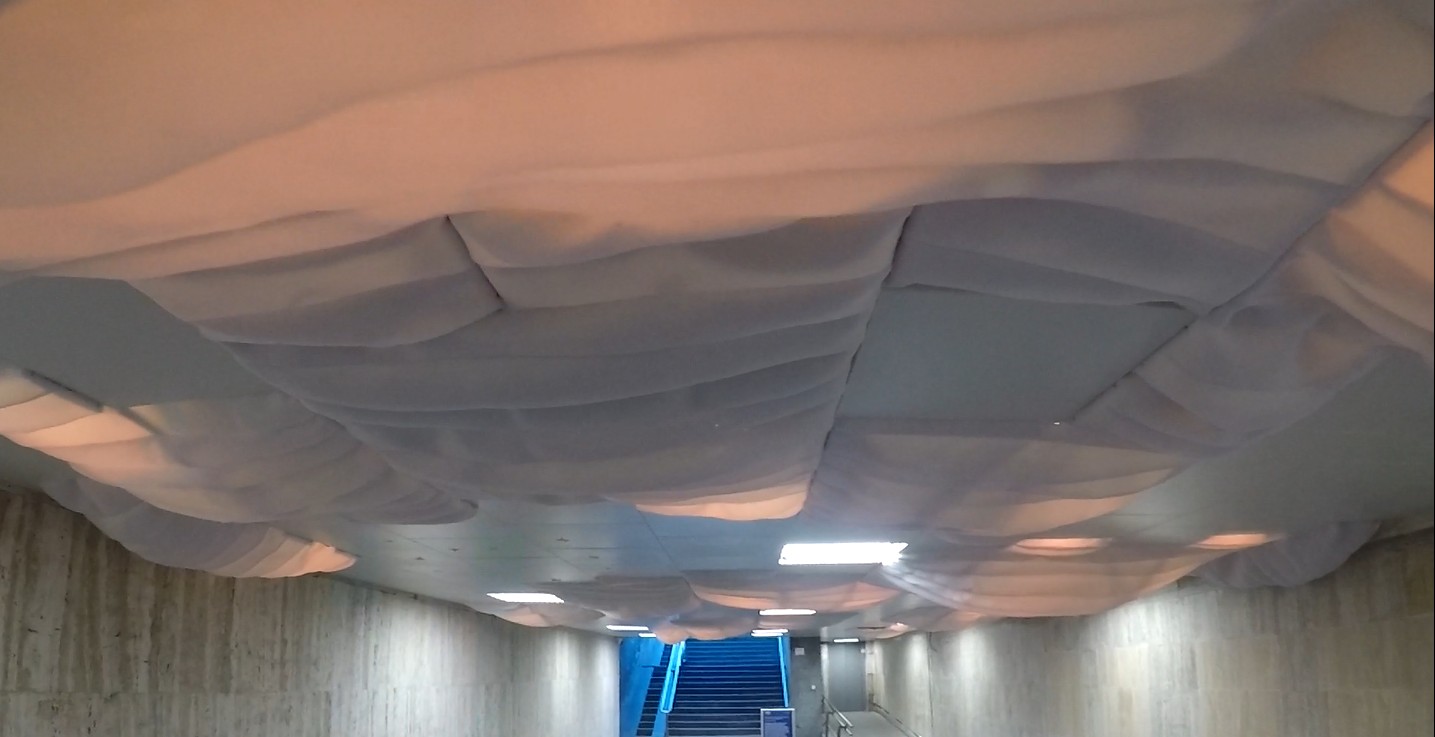
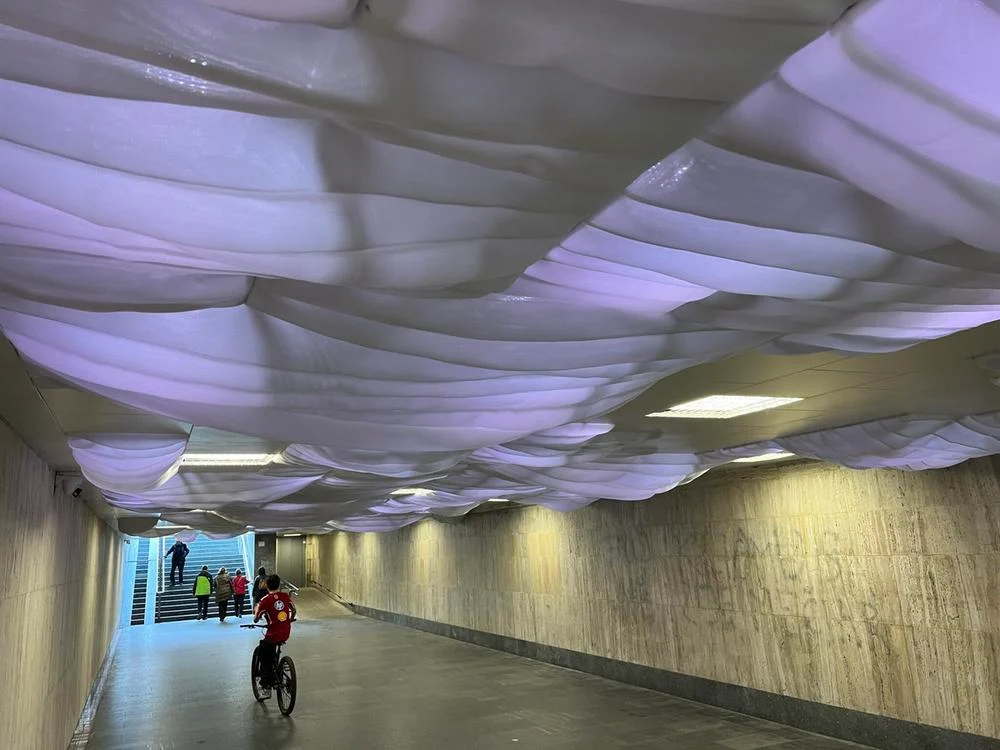
As part of the European Capital of Culture Trenčín 2026, the studio : designed an LED ceiling installation that transforms the space into a soft, immersive environment. Using 130 RGB addressable LED pixels, the ceiling now simulates a moving sky.
A thick white textile layer was installed below the pixels. Once illuminated, it diffuses the light and creates the illusion of clouds flowing across the sky.
The Challenge #
A pixel LED installation in a public underpass comes with real-world constraints:
Weather conditions: Cold, wind, and unstable spring weather made installation physically demanding.
Public operation: The underpass remained fully open, with constant pedestrian traffic during the entire build.
Ceiling construction: It was necessary to drill holes into the structure and mount each LED pixel precisely.
Custom wiring: All pixels were connected using custom-made Ethernet cables, produced directly on-site.
Despite these challenges, reactions from the public were positive from the beginning. People were curious and excited to see the transformation.
Technical Solution #
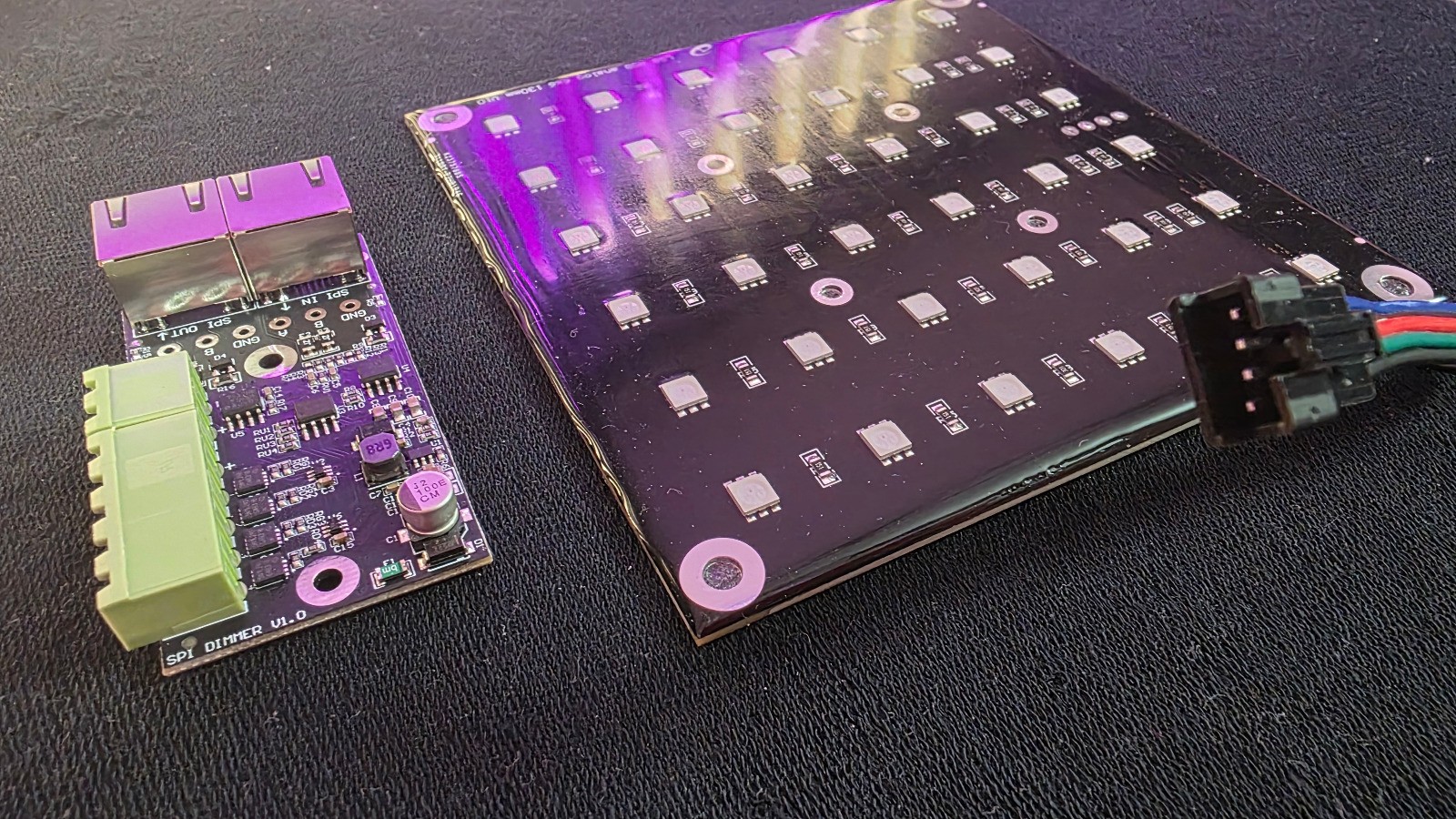
The installation is based on analog RGB pixels controlled via SPI protocol, combining simplicity with precise control.
At the core is an LED Ethernet controller (LEC3) acting as a powerful SPI pixel controller. This type of system is commonly used in professional LED installations and works similarly to an Art-Net LED controller or eDMX to SPI converter.
Key elements of the system:
- addressable LED pixel strip concept
- SPI protocol LED control
- LED Ethernet controller (LEC3)
- custom Ethernet signal distribution
- LED Strip Studio software for programming
In Operation #
The installation is designed to be simple and interactive.
A router hidden in the ceiling enables wireless access. Users can connect via smartphone using and switch between 7 pre-programmed lighting effects.
These effects were created to resemble natural sky movement:
- slow cloud transitions
- soft gradients
- calm ambient lighting
Future Expansion #
The system is ready for live control and performance use.
It can be connected via Ethernet to external software such as:
- LED Strip Studio (LSS4)
This allows real-time control, making the installation suitable for events, performances, or interactive digital art experiences.
Result #
In one week of work by a two-person team, a previously dull and uninviting underpass was transformed into a modern architectural LED installation.
This project shows how addressable LED strip technology, LED mapping software, and thoughtful design can turn everyday infrastructure into a unique visual experience.
FAQ #
What is an addressable LED pixel installation?
An addressable LED installation uses pixels that can be individually controlled, allowing complex animations and lighting effects.What is SPI protocol for LED control?
SPI protocol is a communication method used to send control data from a controller to each LED pixel.How does an LED Ethernet controller work?
It receives data over a network (Art-Net or sACN) and converts it into SPI signals to control LED pixels.Can I control LED installations with a smartphone?
Yes, using apps like LSS Remote, you can connect via Wi-Fi and change lighting effects easily.What software is used for LED pixel mapping?
LED Strip Studio, Resolume Arena, and MadMapper are commonly used for creating and controlling LED animations.How long does a professional LED installation take?
Depending on complexity, installations like this typically take several days to about one week.Project brief #
Studio @buromilk won a commission for an artistic intervention called Jemný podchod as part of Trenčín — European Capital of Culture 2026. The task: humanize an unattractive pedestrian underpass by Hotel Elizabeth on the town’s main artery using light, texture and simple technology.
Hardware & installation #
We installed 130 RGB pixels into the ceiling structure, driven by an LED Ethernet Controller 3 hidden above the ceiling. Pixels were analog RGB bars (SPI-driven) and wired on-site with custom-made Ethernet-style cabling to carry SPI signal and power. To mount the system we drilled holes in the ceiling structure and routed power and data to every pixel; pixels were then covered with a heavy white textile diffuser that, when lit, reads like clouds rolling across the sky.
Installation ran through a full week with two technicians on site, in typical early-spring conditions (wind, cold) and while the underpass remained in daily public use. Public reaction during installation was uniformly positive — passersby looked forward to the transformation.
Software & control #
Effects were authored to resemble daytime sky and drifting clouds. The router concealed in the ceiling hosts the LED Ethernet controller and provides a local Wi‑Fi point; visitors can connect with the LSS Remote app on a mobile phone to choose from seven preprogrammed scenes. The system also supports live performance and wired control via Ethernet for tools such as Resolume, MadMapper or LED Strip Studio (LSS4), making Art‑Net / sACN to SPI workflows possible for future shows.
Notes on compatibility & best practice #
- SPI protocol used for pixel signaling; consider SPI signal extenders or buffers for longer runs.
- Use a suitable power supply with distributed feeds to avoid voltage drop on digital RGB LED strips.
- An Ethernet-capable LED pixel controller (Art‑Net/DMX to SPI) simplifies integration with media servers and mapping software.
Outcome #
A modest, robust LED pixel installation that turned a grey, utilitarian underpass into a gentle, participatory lightscape — installed quickly, serviced easily, and ready for both public interaction and live shows.
Questions
FAQ — Underpass LED installation #
What do I need for a pixel LED installation like this? #
Basic items: addressable RGB pixel strip or bars, compatible LED pixel controller (Art‑Net/LED Ethernet controller to SPI), power supplies sized for total wattage, Ethernet/SPI cabling, mounting/diffuser materials, and pixel mapping software (LED Strip Studio, MadMapper, Resolume).
Why use SPI for these analog pixels? #
SPI protocol offers precise per-pixel control and smooth animations for WS/APA-type pixels; it’s standard for digital RGB pixel strips and supports high refresh rates needed for fluid cloud effects.
How was data wired safely across the ceiling? #
We made on-site Ethernet-style cables to carry SPI/data and paired distributed power feeds. For long runs, use SPI signal extenders/buffers and inject power every 3–5 meters depending on voltage and strip type.
Which controllers and software work for live control? #
An LED Ethernet controller (Art‑Net/ sACN to SPI) was used. The system accepts LSS Remote for mobile selection and can be driven live via Resolume, MadMapper or LED Strip Studio (LSS4) over Ethernet using Art‑Net/sACN.
How to avoid voltage drop on a 130-pixel install? #
Use the correct voltage (5V/12V/24V per strip spec), calculate total current, choose power supplies with headroom, run multiple power injection points, and use thicker gauge wires for main feeds.
Can you change effects? #
Yes — local Wi-Fi via the router in the ceiling lets visitors and admins connect with the LSS Remote app and choose from seven preprogrammed scenes; wired Ethernet control remains available for performances.