

Project Quick Facts
There are clubs where the lighting is an afterthought. Then there are clubs where it is the identity. The Club Bratislava set out to build the second kind — and they thought about it from the ground up.
The Club is the largest nightclub in Bratislava. It sits underground, and one of its most distinctive features is a beautifully tall ceiling — the kind of space that immediately feels grand when you walk in. But having a great space isn’t enough on its own. The client had a clear vision: they wanted every visual element of the club to tell the same story.
One Shape, One Identity #
The concept started with a hexagon. The client chose the six-sided shape as the foundation of the club’s visual identity — it appears in the logo, it influences the interior layout, and it became the basis for the entire LED lighting design.
This kind of unified thinking is rare, and it makes a huge difference. When your logo, your architecture, and your lighting all share the same visual language, guests don’t just see a nightclub — they experience a brand. That impression stays with them long after the night is over.
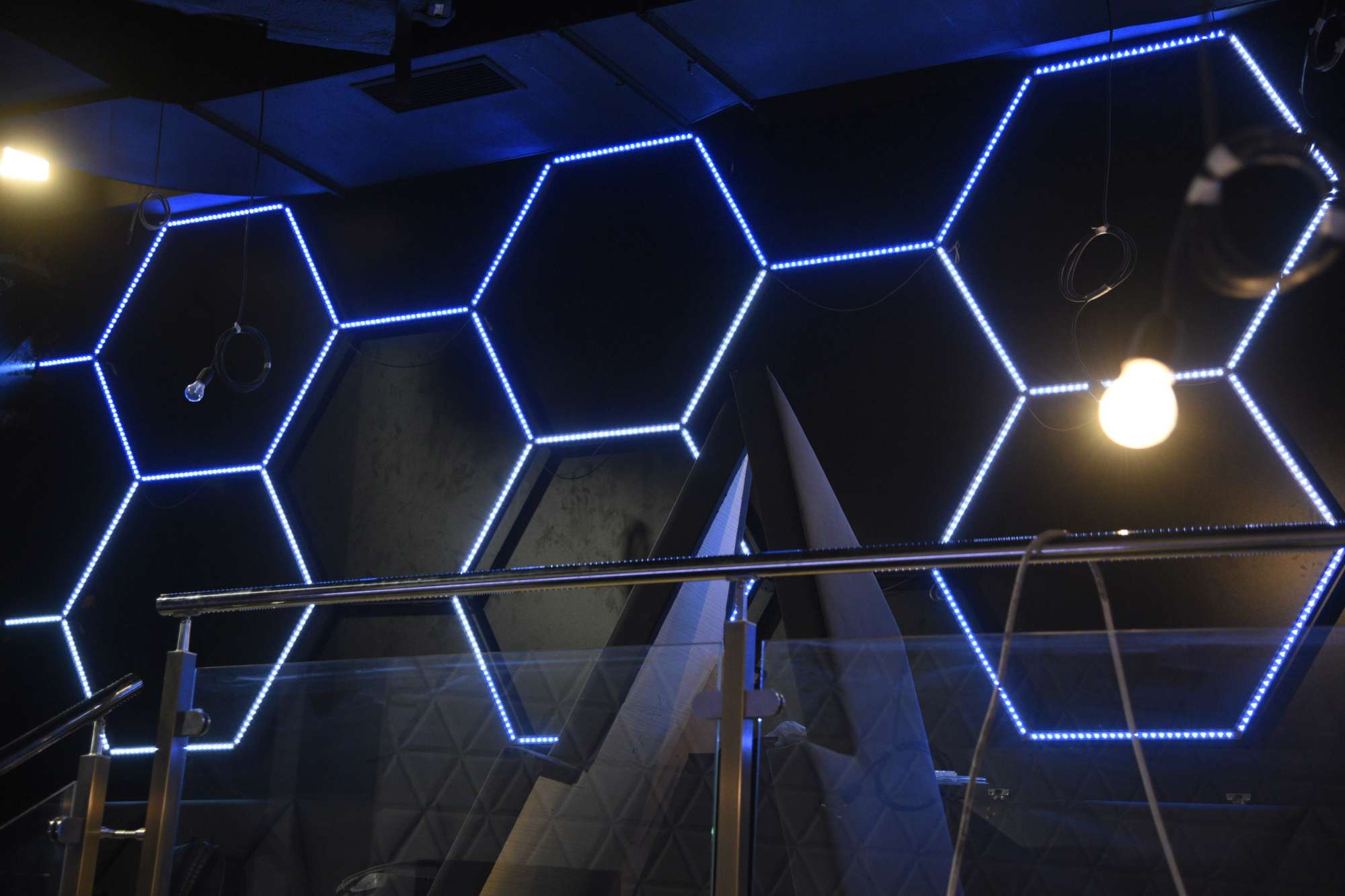
The goal was to build a massive LED pixel wall on the back wall of the club, composed entirely of hexagon shapes made from addressable LED pixel strips. The result: a surface over 40 m² in size, fully dynamic, capable of displaying color transitions, animations, and video content — all in the hexagonal grid that defines the club’s identity.
400 Meters of Addressable LED Strip #
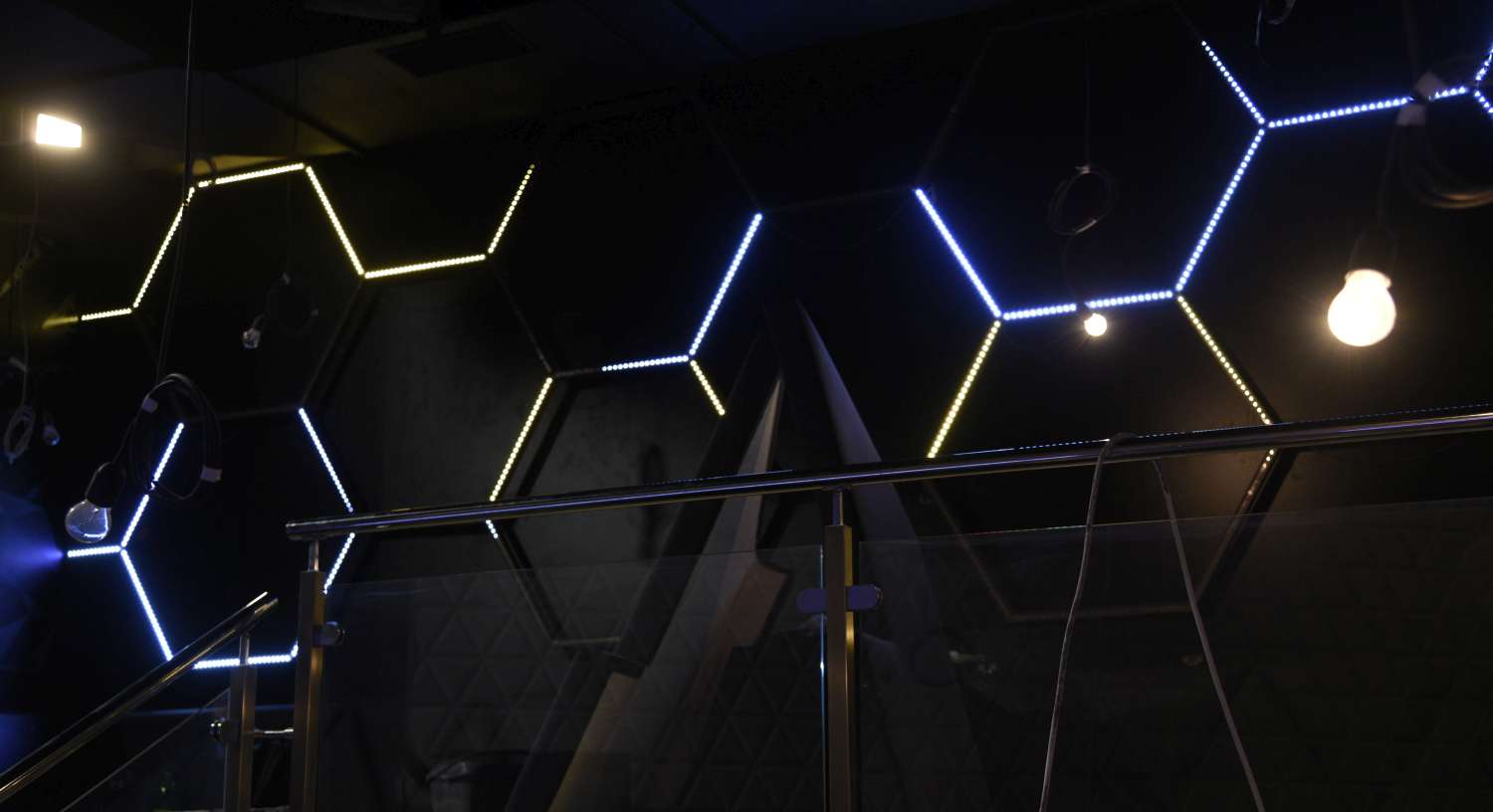
Building a 40 m² hexagon wall out of addressable LED strips is no small job. The installation used more than 400 meters of digital LED strip in total, arranged carefully into the hexagonal pattern across the entire back wall.
Each hexagon is made by bending the SPI addressable LED strip into the six-sided shape and mounting it to the structure. Because every LED is individually controllable, the whole wall behaves like a massive pixel canvas. Effects can flow from one hexagon to the next, colors can transition smoothly across the full surface, and video content can be mapped directly onto the geometry.
The LED pixel mapping for the entire wall was created in LED Strip Studio software. The software lets you draw the physical layout of your installation on a 2D canvas — placing each strip segment exactly where it is in real life. Once the map is built, effects and video content display correctly across the whole structure, no matter how irregular the geometry is.
DMX Control: One Desk for Everything #
The control setup at The Club was designed with practical operation in mind. The LEC3 LED controller was chosen specifically because it accepts DMX commands from an external lighting console — meaning the club operator controls everything from a single desk.
On that desk, they manage the conventional disco lights, moving heads, strobes — and the entire 40 m² LED pixel wall — all at once. No separate computer interface, no switching between systems. A DMX command triggers a pre-programmed scene in LED Strip Studio, and the hexagon wall responds instantly in sync with the rest of the room.
This kind of DMX LED controller integration is a major practical advantage for clubs. The lighting operator during a live night doesn’t have time to manage multiple systems. By routing the LEC3 into the existing DMX setup, the hexagon wall becomes just another fixture on the desk — powerful, but simple to run.
The Result: A Club That’s Impossible to Forget #

The hexagon LED wall at The Club Bratislava delivers on every level. Visually, it’s striking — a 40+ m² surface of animated hexagons covering the back of the main room, fully synchronized with the music and the show. Practically, it’s simple to operate and reliable night after night.
More importantly, it completes the visual identity of the space. Every element of The Club — the logo, the interior geometry, the lighting — speaks the same language. Guests may not consciously notice that, but they feel it. And that’s exactly what makes a place memorable.
When logo, architecture, and lighting all share the same visual identity, the venue becomes a brand. That’s what pixel LED technology makes possible — and that’s what The Club Bratislava built.
Frequently Asked Questions #
How do you build a pixel LED wall using addressable LED strips?
You shape the addressable LED strips into your desired geometry — in this case, hexagons — and mount them to a backing structure. Each strip segment is mapped in LED pixel mapping software like LED Strip Studio, which creates a 2D or 3D canvas matching the physical layout. Once mapped, video, animations, and color effects play correctly across the entire surface. For the hexagon wall at The Club, over 400 meters of strip were used to cover 40 m².
What is the LEC3 LED controller and what makes it good for nightclubs?
The LEC3 is a professional LED pixel controller that supports multiple SPI output channels and accepts both Art-Net and DMX input. For nightclubs, the DMX input is particularly useful — it lets the operator control the pixel LED wall from the same lighting console used for conventional fixtures. No separate computer is needed during the show. Scenes are pre-programmed in LED Strip Studio and triggered via DMX commands from the desk.
How does LED Strip Studio software handle complex pixel mapping?
LED Strip Studio lets you place each strip segment on a virtual canvas that matches your real installation. You draw the position, direction, and length of every strip run. The software then maps any effect, animation, or video source onto that canvas and outputs the correct pixel data to your controllers. For irregular shapes like hexagons, this approach is far more practical than trying to use pre-built panel systems.
Can you control pixel LED strips with a DMX lighting console?
Yes. Controllers like the LEC3 receive DMX commands and use them to trigger pre-programmed scenes stored in LED Strip Studio. The DMX channels act as scene selectors — each channel value calls a different animation or effect. This means a club lighting operator can include the pixel LED wall in their normal show programming, alongside conventional fixtures, without any extra systems at the desk.
How many meters of LED strip does a large nightclub LED wall need?
It depends on the density and size of the design. The hexagon wall at The Club Bratislava covers over 40 m² and used more than 400 meters of addressable LED strip. Denser packing gives a smoother, more video-like result but requires more strip and more power. The spacing between strip runs is a key design decision — too wide and the individual lines become visible; too tight and cost increases sharply. Most large club walls run strips at 20–40mm spacing.
Why does consistent visual branding matter in nightclub design?
When a venue’s logo, interior shape, and lighting all share the same visual language, the space becomes instantly recognizable and memorable. Guests may not consciously notice the connection, but they feel the coherence. The hexagon theme at The Club Bratislava runs through every element — from the logo to the wall geometry to the LED pixel installation — making the club’s identity impossible to separate from the space itself. That kind of branding keeps customers coming back.