

Project Quick Facts
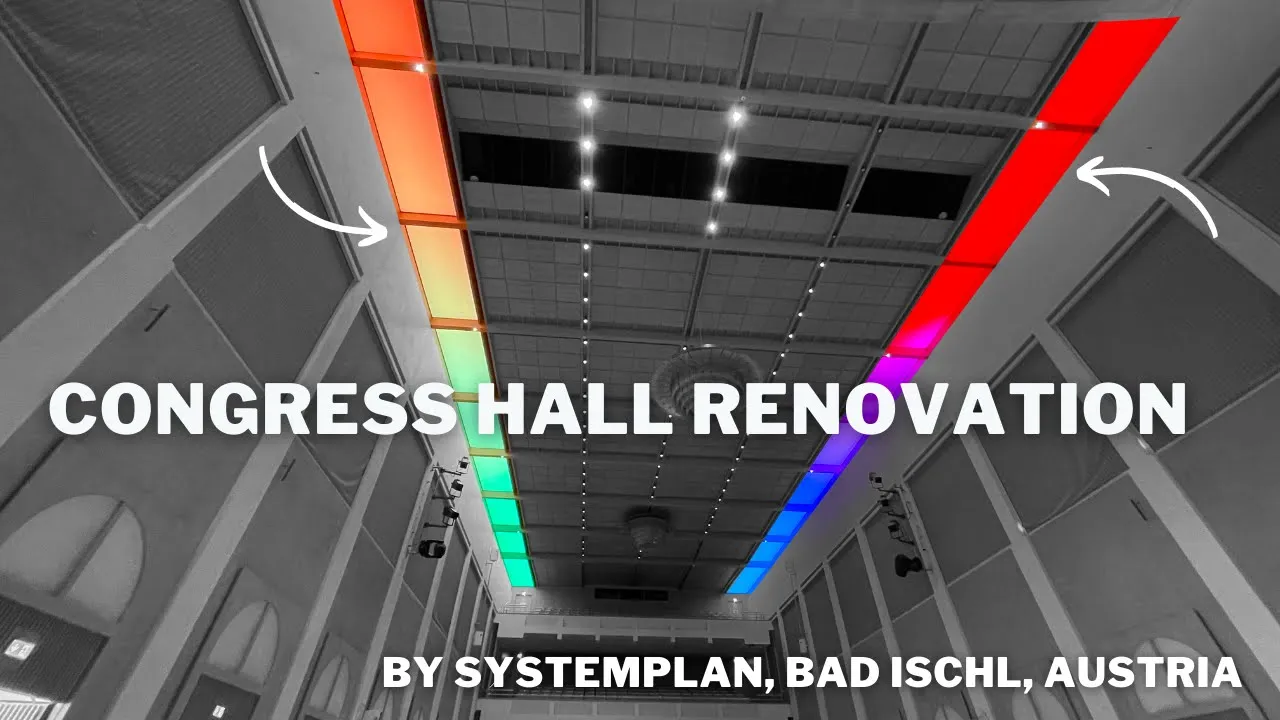
One of our longtime partners from Germany sent us something special — photos and videos from a project he just finished in Bad Ischl, Austria. The town was named the European Capital of Culture 2024, and as part of that designation, the local Congress Hall was completely rebuilt. What they built inside is genuinely stunning.
The installation was delivered by Stefan and the team at Systemplan GmbH. It took 3 people 6 weeks to complete. The result speaks for itself.
Hidden in Plain Sight #
The first thing that gets you about this project is the restraint. The LED pixel installation is not in your face. The strips are hidden — completely invisible when the lights are off. You’d walk into the room and not even notice them.
That’s a deliberate design choice, and a smart one. Cultural venues like congress halls host everything from academic conferences to evening performances. The space needs to work for all of them. A discreet installation that reveals itself only through light fits that requirement perfectly. It doesn’t shout “look at me” — it just transforms the room when the moment calls for it.
This is a great example of what good architectural LED lighting can look like in a public building. The technology serves the architecture, not the other way around.
The Numbers: Two Windows, 38,000 Pixels #
The installation consists of two large illuminated “windows” built into the walls of the hall. Each one measures 31.7 × 1.25 meters — long, horizontal bands of light running across the space.
Together, the two windows contain 38,000 individually addressable pixels. That’s a substantial pixel count, and it translates directly into the resolution and smoothness of what the surfaces can display: text, video content, sweeping color transitions, or soft ambient fills.
To drive all those pixels, the installation uses 20 SPI Matrix devices — professional DMX pixel controllers that receive DMX commands and convert them into SPI output signals for the LED strips. Each SPI Matrix unit handles a portion of the total pixel count, and all 20 units run in sync across the full installation.
Full DMX Control — Text, Video, and Tunable White #
Everything at this installation is controlled via DMX512. That’s a deliberate choice for a cultural venue: DMX is the universal language of professional lighting, and it means any third-party lighting console, media server, or multimedia control system can drive these windows without custom integration work.
The capabilities are broad:
- Color effects and video — the windows can display animated content, color washes, smooth transitions, or mapped video. Any software that outputs DMX or Art-Net can feed them.
- Tunable white light — the windows can also render clean white ambient light, adjustable anywhere from 3,000K (warm white) to 6,000K (cool daylight). This is the practical mode for daytime events and conferences, where dynamic effects would be out of place. The color temperature shift is also DMX-controlled, so it integrates into the venue’s main lighting desk.
The combination of full-color pixel capability and high-quality tunable white in one system is exactly what a multi-use cultural venue needs. The same installation that creates a dramatic visual backdrop for an evening gala produces neutral, functional lighting for a daytime symposium.
Scale and Power #
A project of this scale requires serious infrastructure. The total power consumption across all controllers and power supplies is 20 kilowatts. That’s not a small number — but for 38,000 pixels running at full brightness across two large surfaces, it’s actually a demonstration of how efficient modern addressable LED pixel strip technology has become compared to conventional architectural lighting of equivalent size and output.
The 6-week build time for 3 people is also worth noting. Large professional LED installations in permanent venues involve a lot more than running strips — there’s structural mounting, power distribution, cable management, controller configuration, mapping, and commissioning. The Systemplan team delivered all of that cleanly.
The Outcome #
The renovated Congress Hall in Bad Ischl now has a permanent LED pixel installation that enhances the building without overwhelming it. It can function as subtle architectural lighting or transform into a full dynamic display depending on the event. It connects to any professional lighting system via DMX. And it will be there for years — built properly, to last.
Hats off to Stefan and the Systemplan GmbH team for a beautifully executed project. If you’re looking for inspiration for a similar permanent installation, reach out at [email protected].
Frequently Asked Questions #
What is an SPI Matrix controller and how does it work with DMX?
The SPI Matrix is a professional DMX pixel controller that receives DMX or Art-Net signals and converts them to SPI output for addressable LED pixel strips. In DMX mode, each controller occupies a block of DMX channels — each channel maps to a pixel’s color value. Multiple SPI Matrix units can be daisy-chained or networked to cover large pixel counts. At the Bad Ischl Congress Hall, 20 units were used in parallel to drive 38,000 pixels across two window installations.
What is tunable white LED and how do you control it with DMX?
Tunable white uses RGBW or dual-white LED strips with separate warm and cool white channels. By mixing the intensity of each channel, you can dial in any color temperature between roughly 2700K and 6500K. In a DMX-controlled installation, the color temperature is set by assigning separate DMX channels to each white channel. The lighting operator adjusts the mix from the console like any other DMX parameter — no separate system needed. The Congress Hall installation supports 3000K to 6000K this way.
How many SPI Matrix controllers do you need for 38,000 pixels?
It depends on the pixel density and how many channels each controller handles. The SPI Matrix can drive up to 4,096 pixels per unit (with 4 output channels at 1,024 pixels each). For 38,000 pixels, you theoretically need around 10 units at full capacity — but real installations use more controllers to allow shorter cable runs, better power distribution, and cleaner signal routing. The Bad Ischl project used 20 SPI Matrix units for exactly that reason.
Can pixel LED strips show tunable white light AND full color effects on the same installation?
Yes, if the strips use RGBW LEDs (red, green, blue, and a dedicated white channel). The white channel delivers clean, high-CRI white light that pure RGB mixing can’t match. In full-color mode, the RGB channels run the dynamic effects. In ambient mode, the white channel handles the tunable white output. Both modes are DMX-controllable, so the operator switches between them from the lighting desk without touching the hardware.
How long does it take to install a large permanent architectural LED installation?
It varies significantly with scale and venue complexity. The Congress Hall installation — 38,000 pixels across two 31.7-meter surfaces — took 3 people 6 weeks. That includes structural mounting, power distribution, cabling, controller configuration, pixel mapping, and commissioning. Simpler single-zone installations in smaller venues can be done in days. The key factors are pixel count, physical access difficulty, the number of controllers that need configuring, and how complex the mapping and integration with existing AV systems is.
What third-party software can control a DMX pixel LED installation?
Any software that outputs DMX512 or Art-Net can control a DMX pixel installation. Common choices include grandMA consoles for live events, Resolume Arena for VJ-driven shows, MadMapper for architectural mapping, and MADRIX for complex pixel effects. Because the SPI Matrix controllers accept standard DMX, there’s no proprietary lock-in — the venue can use whatever control system fits their workflow or upgrade it later without touching the LED hardware.