

Project Quick Facts
A Sun Made of 190 LED Pixel Bars #
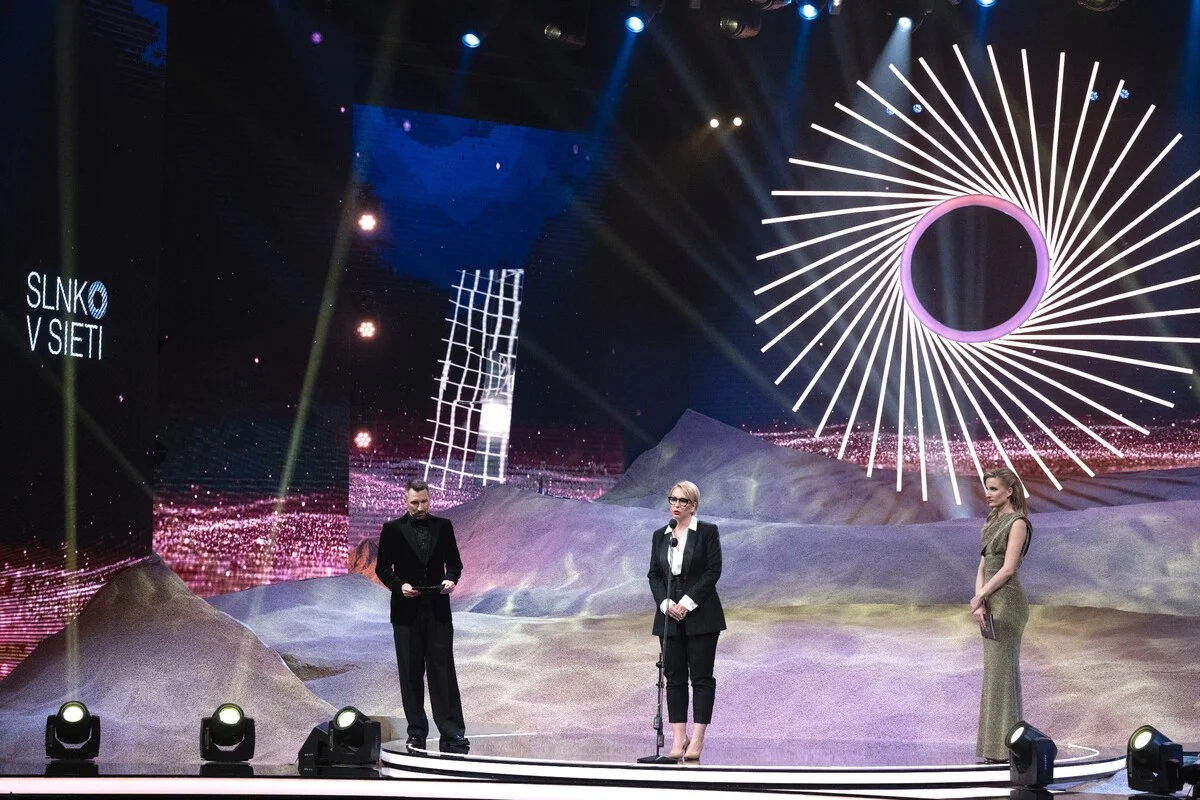
Slnko v sieti — which translates to “Sun in the Net” — is Slovakia’s national film awards ceremony. Every year the creative team pushes for a completely original stage design, and for the 2022 edition they came to us with a concept that suited our ProfiLED bar system perfectly.
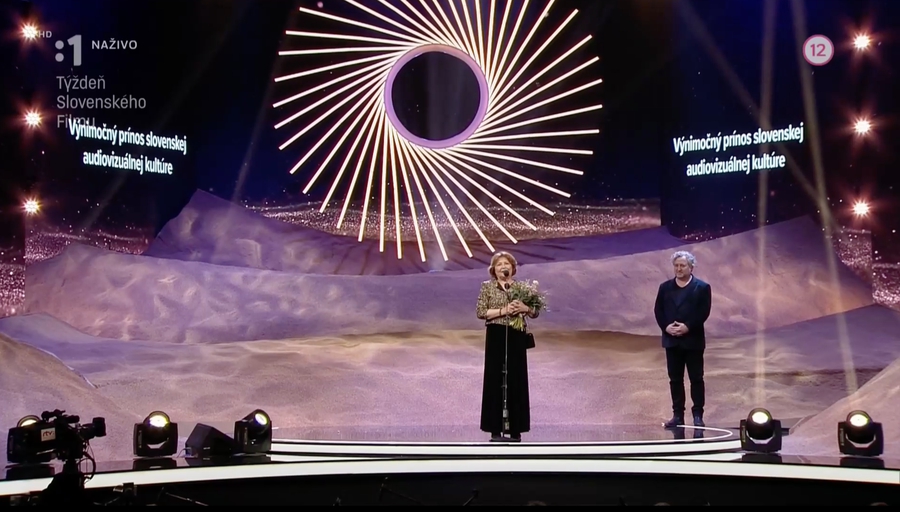
The idea was to build a giant sun out of light. 190 individual one-meter LED pixel bars were arranged radially from a central ring, each one acting as a ray. Together they formed a sun shape that immediately connected the stage to the name of the event itself — while also opening up a huge range of pixel LED stage design possibilities that a flat panel or traditional screen simply cannot offer.
How the Structure Was Built #
The production company fabricated a central circular frame that anchored all 190 rays. This served two purposes: it gave the sun its structural backbone and created the physical space to house the Powered LEC controllers — the units that both drive the ProfiLED bars and supply power directly through the same daisy-chain connection. Keeping the controllers inside the central ring kept cable runs short and the whole rig clean.
The entire structure was suspended from movable cables in the fly system above the stage. This let the director raise and lower the sun during the show — simulating a sunrise and sunset over the ceremony. It is exactly the kind of dynamic stage moment that takes a light installation from decoration to storytelling.
HDMI Grabber Integration: Just Another Layer for the LD #
One of the cleanest parts of this setup was how the LED Strip Studio software was integrated into the production workflow.
The lighting designer was already running a media server for the show. We connected the Intensity PRO HDMI grabber to one of the media server’s video outputs, and LED Strip Studio captured that signal and mapped it in real time across all 190 LED pixel bars. From the lighting designer’s perspective, the sun was just another output layer in their media server — they could push any video, graphic, or live effect from the control console directly onto the pixel LED structure without learning new software or changing their workflow.
This kind of integration is what makes LED Strip Studio software practical on professional productions. The lighting technician does not have to work around the pixel LED system — the pixel LED system works within their existing setup.
Why ProfiLED Works So Well for Awards Shows #
Events like Slnko v sieti have short setup windows, high visibility stakes, and a different design concept every year. That combination makes modular LED bar systems ideal.
Each ProfiLED bar is one meter long, self-contained, and connects to the next with a single cable carrying both power and data. You can arrange 190 of them into a sun, or 200 of them into a grid, or 80 of them into a arch — the geometry is entirely up to the designer. The physical installation goes fast, which matters on a live event schedule where stage time is always scarce.
The LED pixel mapping software in LED Strip Studio then lets you map the full sun shape in software, draw the pixel layout visually, and immediately preview how any effect or video input will look on the actual structure. Changes that would take hours on a standard Art-Net pixel mapping setup can be made in minutes.
For any awards show, TV production, or live event that needs a stage that looks genuinely different every time, ProfiLED bars combined with LED Strip Studio are one of the fastest ways to get there.
Frequently Asked Questions #
What is a ProfiLED bar and how does it work?
A ProfiLED bar is a one-meter self-contained LED pixel bar with addressable RGB pixels built in. Each bar connects to the next in a daisy-chain — a single cable carries both power and SPI data signal. A Powered LEC controller sits at the start of the chain, drives the pixel data, and also supplies power to all connected bars. This means you can install 190 bars with far fewer cable runs than a traditional strip installation would require.
How do you connect a pixel LED installation to a media server?
The easiest method is an HDMI capture card — in this installation we used the Intensity PRO PCI-Express grabber. The media server sends a video output to the capture card, and LED Strip Studio software reads that live video feed and maps it in real time across the pixel layout. For the lighting designer, the LED structure becomes just another output layer of the media server. No extra software, no separate timeline — the LD drives it from the same console they use for everything else.
How do you map an irregular shape like a sun in pixel LED software?
In LED Strip Studio, you draw the physical layout of your bars directly in the LED pixel mapping software. You position each bar or group of bars on a virtual canvas that matches the real structure. The software then shows you a live preview of exactly how any video or effect input will fall across the shape. For 190 radial bars arranged as a sun, you map each ray individually — it takes time, but the visual preview means you catch mapping errors immediately rather than discovering them on stage.
How many ProfiLED bars can one Powered LEC controller drive?
One Powered LEC controller can drive a daisy-chain of ProfiLED bars, supplying both SPI data signal and power through the chain connection. For large installations like this 190-bar sun, multiple controllers are distributed across the structure — in this case housed inside the central ring — so each controller handles a subset of the rays. This keeps signal quality high and avoids voltage drop across long chains.
What makes LED pixel bars better than LED screens for an event stage?
LED pixel bars give a stage designer three-dimensional freedom that flat LED screens cannot match. You can arrange bars into any shape — radial, curved, angular — and suspend them at different depths and heights. Light passes through and around them, so the stage stays visually open. They are also much faster to rig and de-rig than a full LED screen panel system, which matters enormously on an event schedule. The tradeoff is pixel density: bars work best for large shapes and bold effects rather than high-resolution video content.
Can a lighting designer control pixel LED bars from a standard lighting console?
Yes, with the right integration. In this project, the LED Strip Studio software received a live HDMI video feed from the media server already in the production workflow. The lighting designer sent video to the LED structure exactly the same way they sent it to any other screen or projection surface — no separate pixel LED interface needed. Alternatively, LED Strip Studio also supports Art-Net and sACN, so pixel effects can be triggered directly from a grandMA or any other Art-Net-capable console.