
Project Quick Facts
Making a Building Impossible to Miss #
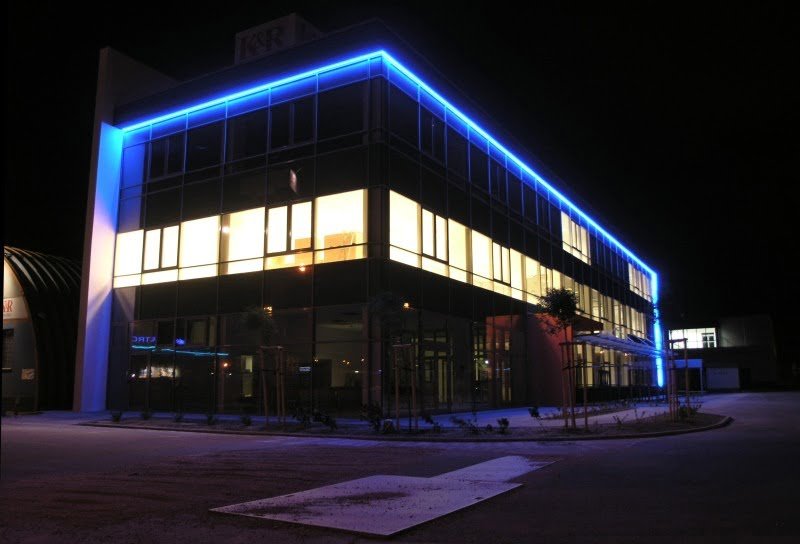
Kon-rad is one of the largest food distributors in Slovakia. When the owner decided to highlight their new building along the highway leading into Bratislava, the goal was simple: make it stand out in the company’s corporate colors so that every car driving past would notice it. The building also houses a discount store, and drawing attention to that was a key part of the brief.
The solution was clear — pure blue LED lighting running the full height of a three-story façade, visible to highway traffic every evening.
Why Pure Blue, and Why Triple Intensity #
Standard LED strips use a package with three or four different color diodes — red, green, blue, and sometimes white. Even on a “blue” setting, you are only using one of those diodes at a time.
For this project, we sourced a specialist pure-blue LED strip where all three diodes inside each package are blue. That means the same strip delivers three times the blue light intensity of a standard RGB strip set to blue. The result is a deep, saturated blue that holds its color at distance and remains clearly visible even in ambient urban light. For a building trying to catch the eye of drivers on a fast-moving road, that extra intensity matters.
The Installation #
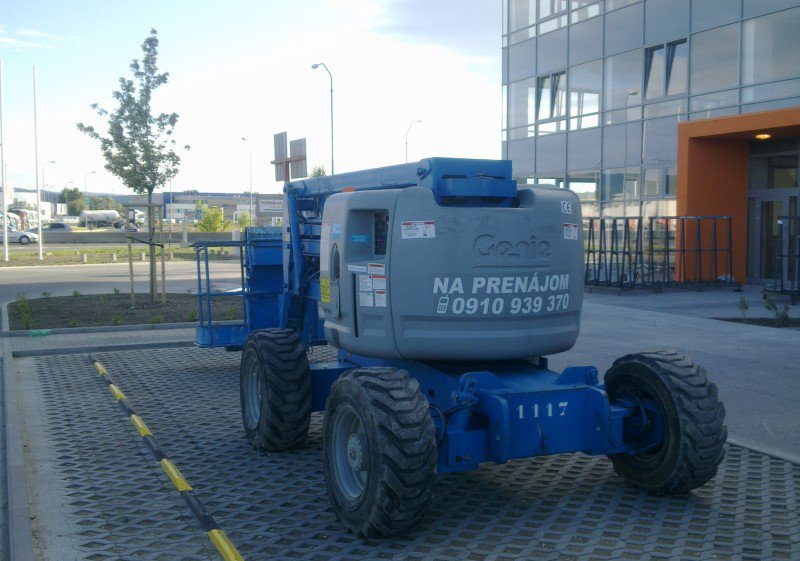
The building is three stories tall, which put the upper mounting points more than 12 meters above ground. Standard ladders were not an option — we hired a telescopic boom lift for the duration of the installation.
Once we had access to the full façade height, the installation itself was straightforward. This is an analog LED system with no controllers. The design intention was for the lighting to run permanently at 100% brightness whenever switched on — no dimming, no color changes, no effects. Because of this, the wiring is direct: 12V power supplies feed the 12V pure-blue analog LED strips without any intermediate controller.
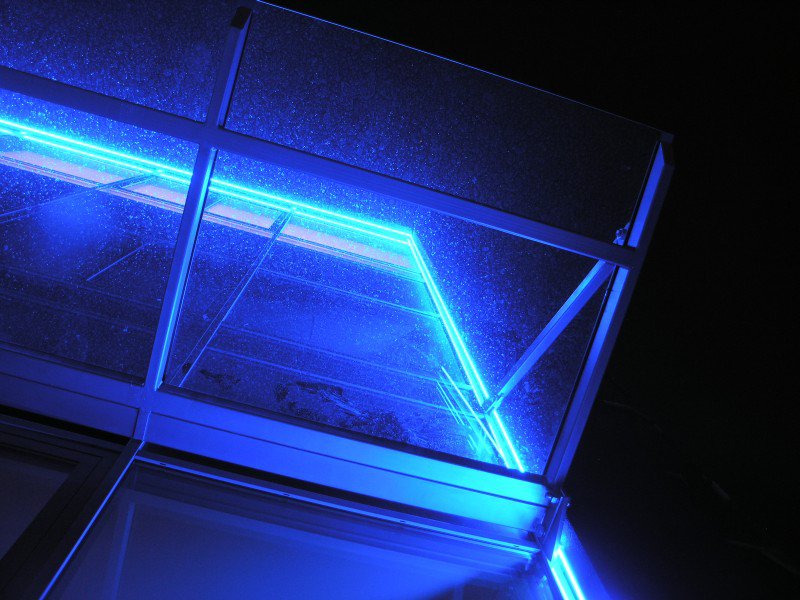
The strips were mounted inside standard aluminum LED profiles, which protect the strip, help with heat dissipation, and give the installation a clean, finished look against the building surface.
Ten Years Running — With One Memorable Surprise #
The installation has been running for over ten years with no significant failures. But shortly after commissioning, the client called to report that sections of the LED strip appeared to be glowing at different intensities.
Our first assumption was that the strip had already developed a fault — not unusual, we thought, for a system running continuously at full power outdoors. The reality turned out to be far more surprising.
When we opened up the profiles to inspect, the LED strip itself was in perfect condition. The uneven brightness was caused by millions of tiny flies that had been attracted by the blue light and had packed themselves into the gap between the strip and the diffuser. In the worst sections, the insects were dense enough to noticeably reduce light output.
We cleaned the profiles, sealed the ends more carefully, and the problem did not return. It was a good reminder that outdoor LED installations always have unexpected variables — and insects attracted to blue-spectrum light are a real one.
The Result #
Today, the Kon-rad parking lot on the approach to Bratislava is a recognizable landmark for anyone who drives that route regularly. The pure blue façade lighting switches on every evening and is visible from the highway exactly as intended — a clear, corporate-colored signal that works as both architectural lighting and outdoor advertising.
Over a decade of reliable operation confirms what the simple design was built on: a direct 12V circuit, quality pure-blue strips, solid aluminum profiles, and no unnecessary complexity.
FAQ #
What is a pure blue LED strip and how is it different from a standard RGB strip?
A pure blue LED strip uses packages where all diodes are blue rather than splitting the package between red, green, and blue. In a standard RGB LED strip, setting the output to blue activates only one of the three diodes, giving a fraction of the total light output. In a pure blue strip with three blue diodes per package, the blue light intensity is roughly three times higher. This makes a significant visual difference on large outdoor installations viewed from a distance.
What is an analog LED strip and how does it differ from an addressable strip?
An analog LED strip runs all LEDs on the strip at the same brightness and color simultaneously. You control the whole strip using voltage — at 12V full power, the strip glows at maximum brightness. There is no per-pixel addressing. An addressable LED strip (like WS2812B or WS2815) has a chip at each LED position, allowing individual control. For applications where the entire strip should run at constant full brightness with no effects, analog LED strips are simpler, cheaper, and highly reliable.
Can analog LED strips run permanently without a controller?
Yes — this is one of the main advantages of analog LED strips. When the installation goal is to run at 100% brightness continuously, the power supply connects directly to the strip with no controller in between. This reduces the number of components and potential failure points. The 12V analog LED strip in this installation has run this way for over ten years with no controller-related issues.
What are aluminum LED profiles used for in outdoor installations?
Aluminum LED profiles serve several purposes: they provide a clean mounting channel for the strip, protect the strip from physical damage, help dissipate heat along the full length of the strip, and hold the diffuser cover that spreads and softens the light output. In outdoor façade installations, they also help seal the strip against dust and moisture, though — as this project showed — end caps and diffuser seals need to be chosen carefully to prevent insects from entering the channel.
What should I consider for outdoor LED installations on buildings?
Outdoor LED installation on a building façade introduces challenges that do not appear in indoor work: moisture, UV exposure, temperature variation, and — as this project demonstrated — insects attracted to certain wavelengths of light. Key considerations include choosing profiles with IP-rated diffusers, sealing cable entry points, selecting power supplies rated for outdoor or at least enclosed operation, and planning for access if maintenance is needed at height. For tall buildings, budget for aerial access equipment such as a boom lift or scaffolding during both installation and any future service visits.
Why does blue light attract insects?
Insects navigate using ultraviolet and short-wavelength visible light. Blue LED light sits near the UV end of the visible spectrum and is more attractive to many flying insects than green, yellow, or red light. In this installation, the high-intensity pure blue façade created a strong draw for local insect populations, particularly during warm evenings shortly after the system was first switched on. Sealing the profiles after the initial cleaning prevented the problem from recurring.