

Project Quick Facts
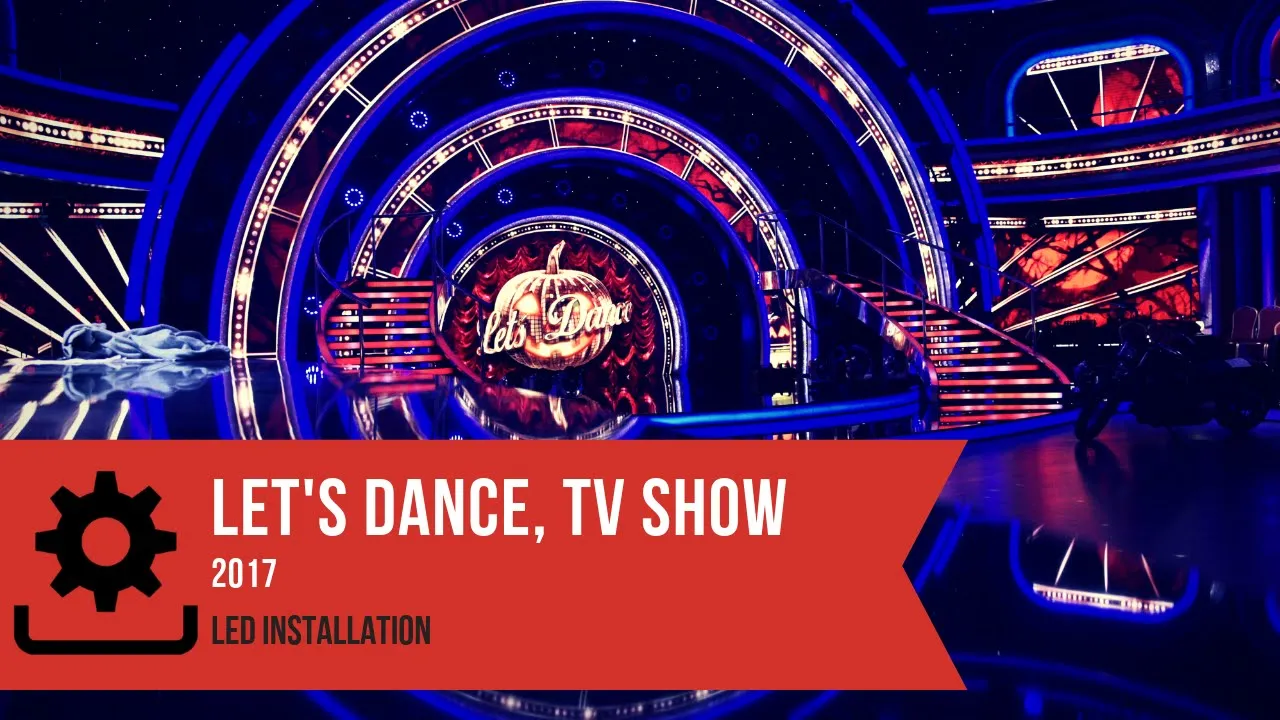
Let’s Dance is one of the most popular TV shows in Slovakia. It’s a celebrity dance competition that runs every spring — about six weeks, one live round per week. Because the show needs a huge space for its performances, the production team rents out a convention exhibition hall every season and builds the entire TV studio from scratch. Everything — lighting rigs, set walls, stages — goes up and comes down each year.
That temporary nature is actually where our products shine.
Over 1,200 Metres of Analog LED Strip #
The set design called for a dramatic, high-impact look. To pull it off, the lighting team installed more than 1,200 metres of analog LED strip across the studio — wrapping walls, framing set pieces, and filling the space with color. For a build that gets torn down and reassembled every season, fast and flexible installation is everything.
That’s where our Mr. Dimmer units came in. With about 30 Mr. Dimmer controllers on set, the team could quickly connect and power up to 120 independent LED segments — each one controlled over DMX512 using 3 RGB channels. No complex custom wiring. Just plug in, assign a DMX address, and the lighting operator has full control from the console.
Digital Pixel Walls with SPI Matrix #
The set architect wanted more than static color. For the surrounding walls, the team used digital addressable LED pixels, with each pixel driven independently by our SPI Matrix controller. This kind of per-pixel control lets the lighting team run real digital effects — chases, morphs, video content — across the entire wall surface. It’s a completely different look from analog strips, and on a live TV show it makes a huge visual impact.
LED Stairs — The Star Entrance #
One of the most striking elements of the whole set is the staircase. The main celebrity performers walk down digital LED stairs at the start of each performance, and the lighting has to be perfectly synced with the music and the moment.
Those stairs are driven by our Powered LEC — the rental-ready version of the LEC3 controller with a built-in power supply. No separate power brick needed, which keeps the installation clean and fast to deploy.
The lighting operator runs the stairs through LED Strip Studio 3 software, using an HDMI grabber to feed video content directly into the pixel map. Inside their ChamSys lighting console, a dedicated HDMI layer is reserved just for the staircase — because the effect is so good, the operator wanted direct visual control to match it with the rest of the rig in real time.
LED Dancers on Stage #
For some of the show’s headline performances, we also brought in our LED dancer suits — performers fully kitted out in wearable pixel LED costumes. It pushed the visual spectacle even further, and the audience loved it.
Still Running Strong #
Let’s Dance is now in its 10th season — a milestone that says a lot about the show’s popularity. We’re proud our plug-and-play LED system has been part of making it look this good, year after year.
What is the difference between analog and digital LED strips for a TV studio?
Analog LED strips treat an entire segment as one light source — the whole strip changes color together. They’re great for large areas like walls and ceilings where you want consistent color quickly and affordably. Digital (addressable) LED strips give you per-pixel control, so each LED can be a different color. For a TV studio, you typically use analog strips for ambient fill and digital strips for feature zones where animated effects or video content matter.
How do you control a large number of LED segments quickly in a temporary installation?
For fast, temporary setups like TV studios or event stages, DMX-based LED controllers such as Mr. Dimmer are the practical solution. Each unit can power and control multiple independent LED segments over standard DMX512 using RGB channels. Because DMX addressing is simple and the controllers are self-contained, a lighting operator can patch the whole rig in a fraction of the time it would take with a custom-wired system.
How does an SPI Matrix controller work for pixel LED walls?
An SPI Matrix controller receives pixel data (usually over Art-Net or sACN from a lighting console or media server) and converts it into an SPI signal that drives each individual LED pixel on your addressable strips. This lets you control thousands of pixels independently, enabling real video-style effects, gradients, and animations across an entire wall surface — effects that aren’t possible with analog strips.
How do you sync LED stairs with a live performance on a talent show?
The most reliable method is using pixel control software like LED Strip Studio 3 with an HDMI grabber. The lighting operator creates visual content that maps directly to the stair pixels, feeds it through an HDMI source, and reserves a dedicated layer in the lighting console for it. This gives the operator real-time visual feedback and lets them manually trigger or time the stair effects to match the performer’s entrance and the music cue.
What is a Powered LEC and why is it useful for rental events?
The Powered LEC is a version of the LEC3 pixel LED controller with an integrated power supply built into the same unit. For rental and temporary installations — like a TV show stage that gets built and struck every season — having power and control in one box simplifies wiring, reduces the number of components to manage, and speeds up deployment significantly.
How are LED dancer suits controlled during a live show?
LED dancers were provided by our Tron Event Agency brand. They are typically controlled via wireless DMX. To synchronize them with the TV studio timing, we use MIDI MTC timecode (or LTC in TV studio environments).